
Introduction
PACIFIC CONSULTANTS GROUP (hereinafter referred to as "our group") aims to lead to a sustainable society by achieving both "a prosperous life free from inequality and in which no one in the world is threatened" and "protecting the beautiful Earth, the source of all life, and its environment, and passing it on to future generations."
To embody this philosophy and to ensure the sustainable growth and long-term enhancement of corporate value of our group, PACIFIC CONSULTANTS HOLDINGS CO., LTD. (hereinafter referred to as "the Company"), as a privately held company, will strengthen its own discipline, build and operate sound and transparent corporate governance, and strive for continuous improvement to further enhance it.
As the fundamental principles and framework of our corporate governance, we have established the following "Corporate Governance Charter" and "Basic Policy on Corporate Governance."
Corporate Governance Charter
1. Unwavering efforts toward establishing and improving corporate governance.
Our group's management will autonomously and continuously undertake initiatives to establish and improve corporate governance, always recognizing the results of these efforts, and continuing our tireless efforts to enhance corporate value.
2. Enhancing corporate value and contributing to society from a long-term perspective.
Our group aims not only to generate short-term profits, but also to conduct business with a long-term perspective, striving for sustainable growth and increased corporate value, while also contributing to the sustainable development of local communities.
3. Ensuring transparency and accountability to stakeholders such as shareholders, society, customers, and employees.
Our group will ensure transparency in management and establish strong governance by fulfilling appropriate accountability to all stakeholders, including shareholders, society, customers, and employees.
4. Board of Directors that fulfills its responsibility toward sustainable growth and enhancement of corporate value.
Our group's Board of Directors will provide a compass for management, possess a highly effective supervisory function, and create an environment where each employee can act autonomously in order to achieve sustainable growth and enhance corporate value.
5. Promoting and communicating thorough compliance.
As a company responsible for developing social infrastructure, our group strongly recognizes that thorough compliance is a fundamental prerequisite for our management. We will vigorously promote compliance and communicate our efforts to society in order to serve as a model for the industry.
Corporate Governance Basic Policy
Chapter 1: Corporate Governance System
PACIFIC CONSULTANTS HOLDINGS CO., LTD. (hereinafter referred to as "the Company") has adopted a corporate structure with an audit and supervisory committee as its organizational structure under the Companies Act. This structure ensures that Board of Directors appropriately exercises its supervisory function, delegates some decisions regarding important business execution to Director, and aims to expedite decision-making and business execution.
Furthermore, as part of Board of Directors, the Audit and Supervisory Committee has the function of auditing and supervising the execution of duties by Director, and we will work to improve corporate governance by strengthening both functions.
Furthermore, to complement the functions of Board of Directors, optional committees such as an Internal Control Committee and an optional Nomination and Compensation Committee may be established as needed.
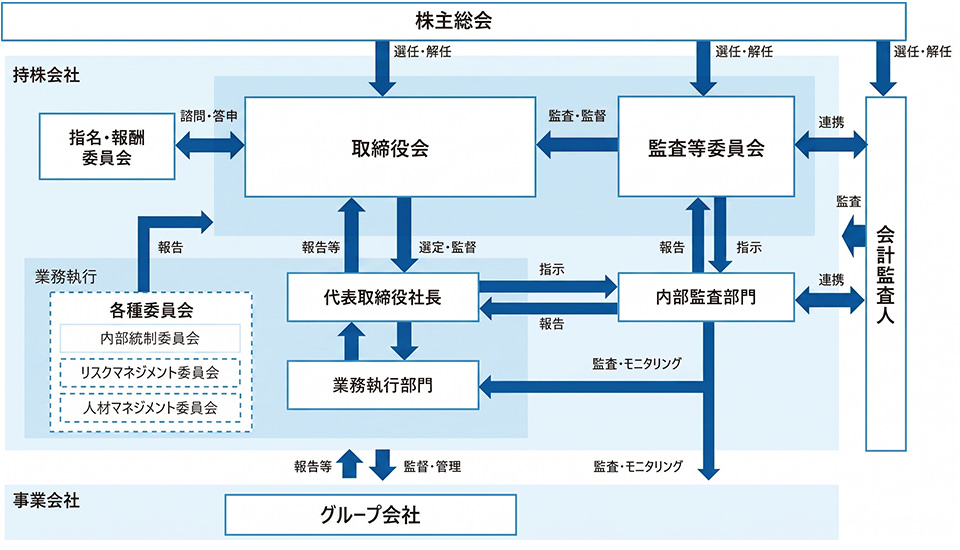
*Group companies include PACIFIC CONSULTANTS CO., LTD., Ltd. and other major operating company.
Corporate Governance System
Chapter 2: Roles and Functions of Board of Directors, etc.
1. Board of Directors
(1) Role and function of Board of Directors
Board of Directors, in accordance with its fiduciary duty and accountability to shareholders, has the following functions in order to appropriately fulfill its role in enhancing fairness, transparency, and efficiency in management, and in promoting the sustainable growth of the Group and improving corporate value in the medium to long term.
- Decision-making function: Makes decisions on important business operations such as the group's management strategy and plans, resource allocation, organization and personnel, capital policy, internal control systems, and risk management.
- Supervisory function: Supervises the execution of duties by Director, as well as the establishment and operation of corporate governance, internal control systems, and risk management systems.
- Self-check function: Based on the role that the company should play as a privately held company, Board of Directors will appropriately exercise its authority and improve the corporate governance of the group.
(2) A framework for the structure of Board of Directors, based on the premise that the Board of Directors will be able to perform its functions.
In order to properly exercise the functions of Board of Directors as defined in the preceding paragraph, Board of Directors shall specify the skills and other requirements that all Director should possess, and shall be composed of Director have a balance and diversity of knowledge, experience, and abilities, and shall be of an appropriate size for effective functioning, consisting of no more than five Director (excluding Director who are audit and supervisory committee members; hereinafter referred to as Director") and no more than five Director are audit and supervisory committee members (hereinafter referred to as "audit and supervisory committee members"). Furthermore, the Audit and Supervisory Committee shall be composed of three or more audit and supervisory committee members, and the majority of them must be Outside Director.
(3) Delegation of decision-making on important business operations to Director
Board of Directors delegates some of the decision-making power for important business operations to Director, thereby accelerating decision-making and business execution by allowing for more thorough deliberation on matters of particular importance.
(4) Appointment of Director and Audit Committee Members
The appointment of Director and audit committee members is based on the principle of a composition that ensures the effective functioning of Board of Directors, and candidates will be determined through the following appointment procedures.
When appointing Director, the President and Director prepares a proposal for the appointment of Director candidates, which is then submitted to the Nomination and Compensation Committee for consultation and advice, followed by deliberation by the Audit and Supervisory Committee, and finally decided upon by Board of Directors.
In appointing members of the Audit and Supervisory Committee, President Director the Audit and Supervisory Committee members will consult with each other to prepare a list of candidates for the Audit and Supervisory Committee members. After consultation with and receiving a report from the Nominating and Compensation Committee, and obtaining the consent of the Audit and Supervisory Committee, the appointment will be decided by Board of Directors.
(5) Remuneration of Director and Audit Committee Members
Director' compensation is determined by Director President, who prepares a compensation policy that sets out the percentage of performance-linked compensation, evaluation methods, etc., so that it functions as an incentive to enhance long-term corporate value. This policy is then consulted with and reported to the Nominating and Compensation Committee, deliberated by the Audit and Supervisory Committee, and finally approved by Board of Directors.
The remuneration of audit and supervisory committee members will be determined through consultation among the committee members, taking into consideration the conflict between audit and supervisory functions and performance-linked compensation.
(6) Internal control system
Board of Directors formulates a "Basic Policy on the Development of an Internal Control System" in order to ensure that business operations are conducted under appropriate control. This basic policy is reviewed by Board of Directors after the Internal Control Committee deliberates on its development and operation, and after taking into account the opinions of the Audit and Supervisory Committee.
(7) Development of successors and management personnel
Board of Directors consults with the Nomination and Compensation Committee to confirm and discuss basic policies and programs regarding the succession of Representative Director and the development of next-generation management talent, and receives a report from the Committee. The Board also monitors the progress of the development of successor candidates and management talent in a timely manner.
(8) Evaluation of the effectiveness of Board of Directors
Board of Directors will annually analyze and evaluate Board of Directors effectiveness based on self-assessments by each Director. Furthermore, it will continuously implement necessary measures to maintain and improve the validity and objectivity of the evaluation methodology and address any identified issues, thereby enhancing the effectiveness of Board of Directors.
2. Director *In this chapter, "Director" includes Director who are audit and supervisory committee members.
(1) Roles and responsibilities of Director
In light of their fiduciary duty to shareholders, Director are tasked with achieving sustainable enhancement of corporate value and are bound by a duty of loyalty and due care in the performance of their duties.
Executive Director oversee the overall business operations of the entire group in accordance with the medium- to long-term management policies approved by Board of Directors, and report the status to Board of Directors. They also ensure close cooperation among Director, including providing Outside Director with appropriate information to facilitate effective discussions at Board of Directors.
Outside Director, in addition to their responsibilities as Director, contribute to improving the quality and effectiveness of Board of Directors discussions by offering suggestions and advice based on their own knowledge and experience from an independent and objective standpoint. Their main roles include "offering appropriate suggestions and advice on management policies and strategies, internal controls and risk management," "supervising management, including the appointment and dismissal of management personnel," and "supervising and advising on the development and operation of internal control systems, compliance, and various risk responses, including conflicts of interest."
(2) Support system for Director
Our company will establish a system that provides support for Director to obtain useful information and, when necessary, to obtain advice from external experts in order to fulfill their roles and responsibilities.
For part-time Outside Director, Board of Directors Secretariat will provide prior explanations regarding matters to be submitted to Board of Directors and provide necessary information.
(3) Training policy for Director
Our company will provide opportunities for Director to acquire and update their knowledge as needed, so that they can properly fulfill their roles and responsibilities.
3. Audit and Supervisory Committee and Audit and Supervisory Committee Members
(1) Role of the Audit and Supervisory Committee
The Audit and Supervisory Committee, working in cooperation with Board of Directors, plays a key role in oversight and is responsible for establishing a sound corporate governance system as a statutory, independent body that audits and supervises the execution of duties by Director.
The Audit and Supervisory Committee is responsible for auditing and supervising the execution of duties by Director, deciding on proposals regarding the appointment and dismissal of accounting auditors, and exercising the right to express opinions on the appointment and dismissal of Director other than Audit and Supervisory Committee members, as well as their compensation.
The Audit and Supervisory Committee instructs the internal audit Dept. to conduct necessary investigations, receives reports from it, and establishes a collaborative system with the external auditors and the corporate Audit & Supervisory Committee Member of subsidiaries to ensure the effective functioning of the auditing system throughout the entire group.
(2) Roles and responsibilities of audit and supervisory committee members
In light of their fiduciary duty to shareholders, the Audit and Supervisory Committee members shall perform their duties as Director who are also Audit and Supervisory Committee members and strive to exercise an effective supervisory function.
Audit and supervisory committee members shall audit and supervise the execution of duties by Director, maintaining an independent and objective position and exercising their authority proactively and actively.
4. Optional Meetings
(1) Internal Control Committee
The Internal Control Committee aims to develop the "Basic Policy on the Development of the Internal Control System" for our group, and to monitor and improve its implementation status.
The Internal Control Committee reports important matters related to internal control to Board of Directors and the Audit Committee, and makes recommendations for revisions to the basic policy regarding the development of the internal control system.
(2) Nomination and Compensation Committee
The Nomination and Compensation Committee is involved in the selection and dismissal of the Group's management team (Director, President, managing directors, and other executive officers), the determination of compensation policies, and the development of successor candidates and management talent. Its purpose is to improve the transparency, fairness, and objectivity of the Group's corporate governance and to strengthen Board of Directors' self-checking function.
The Nomination and Compensation Committee discusses and monitors matters in response to consultations from Board of Directors and submits recommendations to Board of Directors.
Chapter 3: Ensuring Appropriate Information Disclosure and Transparency
To ensure transparency and fairness in business activities, we will proactively disclose information based on our public relations strategy, fulfilling our accountability to each stakeholder regarding financial and management information, management policies and strategies, governance and compliance, and social and environmental information.
Chapter 4: Ensuring Shareholder Rights and Equality, and Dialogue
1. Securing shareholders' rights
Our company will ensure that shareholders' rights, including voting rights at General Meeting of Shareholders are effectively protected, and that an environment is created that allows them to exercise those rights appropriately.
2. Basic principles of capital policy
Leveraging the advantages of being a privately held company, our group aims to meet shareholder expectations by determining the optimal capital/debt structure, shareholder structure, and methods for achieving sustainable growth and long-term corporate value enhancement, as well as by realizing growth investments and a business portfolio that prioritizes capital efficiency.
3. Dialogue with shareholders
President Director be responsible for dialogue with shareholders, and will strive to ensure constructive and meaningful conversations.
Chapter 5: Appropriate Collaboration with Stakeholders Other Than Shareholders
1. Formulation and Implementation of Our Behavior
Our group has established a "Corporate Code of Conduct" and is working together as a group to aim for the sound and sustainable development of the company. Director will lead by example based on high ethical standards and a spirit of legal compliance, and will work to ensure that these codes are understood and enforced throughout the company.
2. Social and Sustainability Initiatives
Based on the deep knowledge and trust we have cultivated through the social infrastructure services we have provided, our group will work together with our stakeholders, including shareholders, society, customers, and employees, to realize a sustainable society.
3. Initiatives for Diversity, Equity & Inclusion
Our group respects the diverse knowledge, experience, values, and individuality of each employee, and promotes "diversity, equity, and inclusion management" that leverages and integrates the strengths of individuals and teams to deliver value.
Supplementary Provisions
1. This policy shall come into effect on January 5, 2026 (Reiwa 8).