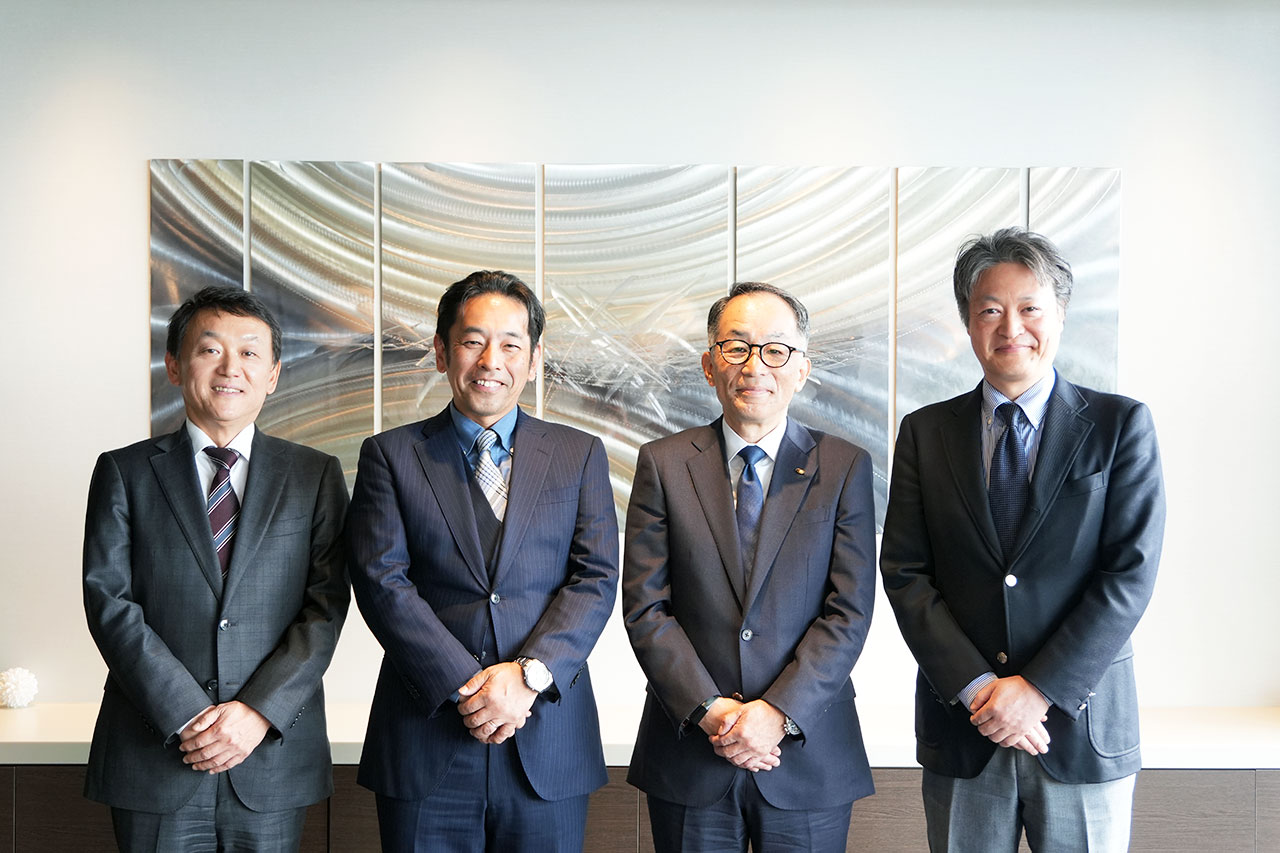


In October 2025, PACIFIC CONSULTANTS established the "River Basin Sediment Management Research Area" as an endowed research Dept. at Kyoto University's Disaster Prevention Research Institute. The new research organization, "RiSM" (River Basin Sediment Management Lab.), has already begun operations, and has set an ambitious research theme that is unprecedented worldwide: "aiming to develop efficient and effective landslide prevention technologies through dynamic river management." The four faculty members in charge, Professor Hirofumi TAKEBAYASHI and Lecturer Masato KUWAHARA, along with our Representative Director, President Executive Officer Osamu OMOTO, and Chief Technical General Manager Ryoji HIRAKAWA, discussed future research and the outlook for social implementation.
INDEX
- It is becoming increasingly important to consider rivers and sabo (erosion control) as a single entity.
- Changing the world through research schemes
- The significance of co-creation between Disaster Prevention Research Institute, Kyoto University and PACIFIC CONSULTANTS
It is becoming increasingly important to consider rivers and sabo (erosion control) as a single entity.
- First, please tell us about Disaster Prevention Research Institute, Kyoto University.
Takebayashi: The Disaster Prevention Research Institute was established in 1951. Shortly after the war, Japan was hit by a series of major typhoons and earthquakes, and there was a growing awareness of the need to strengthen research into disaster theory and disaster prevention. Later, social science elements such as evacuation and disaster prevention education were added, and the institute is now made up of four sector: "Earthquakes and Volcanoes", "Geography", "Atmosphere and Water", and "Comprehensive Disaster Prevention". The River Basin Sediment Management Research Area, RiSM, was established within the Climate Change Adaptation Research Center, which is part of the Atmosphere and Water Research sector.
- Professor TAKEBAYASHI, did you originally focus your research on landslides?
TAKEBAYASHI: Before coming to Kyoto University, I was actually researching river environments. I think many researchers overseas recognize me as an expert in that field. I studied river topography, researching what kind of topography is comfortable for river creatures to live in and what makes river inundations less likely. Disaster prevention is also considered for the creatures living in the river, but river development cannot be achieved by thinking only about the creatures. Also, river development cannot be achieved solely from the perspective of disaster prevention, i.e., stopping flooding, so I believe that "RiSM" will enable us to conduct research that strikes a good balance between these two.
- Pacific PACIFIC CONSULTANTS was also founded in 1951.
OMOTO: Coincidentally, we are both at the Disaster Prevention Research Institute. Since the time of Japan's postwar reconstruction, we have been responsible for the research, planning, design, and maintenance of basic social infrastructure, including railways, roads, rivers, and ports. Recently, the frequency and severity of disasters due to global warming has become more pronounced. Rainfall patterns are different from before, and damage caused by erosion control, such as mudslides, is increasing rather than river flooding. Responding to new landslides is a major social issue today. We also work in the fields of rivers and erosion control, but in our work, river planning and management are inseparable from sediment issues. However, rivers and erosion control have different academic societies, and the government sectors are vertically divided and completely separate. Professor Takebayashi, however, is one of the few researchers worldwide with expertise in both rivers and erosion control. We hope that the establishment of this endowed research Dept. will serve as an opportunity to further accelerate our research.
Changing the world through research schemes
- What is the goal of the new research sector?
TAKEBAYASHI: I always talk about "changing the world" through research and development. If we can change society for the better even a little through our research, we will feel glad to be doing this kind of work and glad to be alive. We aim to use the scheme of our research to gain the understanding of society and move the world in a better direction.
- So you're promoting research that can be implemented in society and make society better.
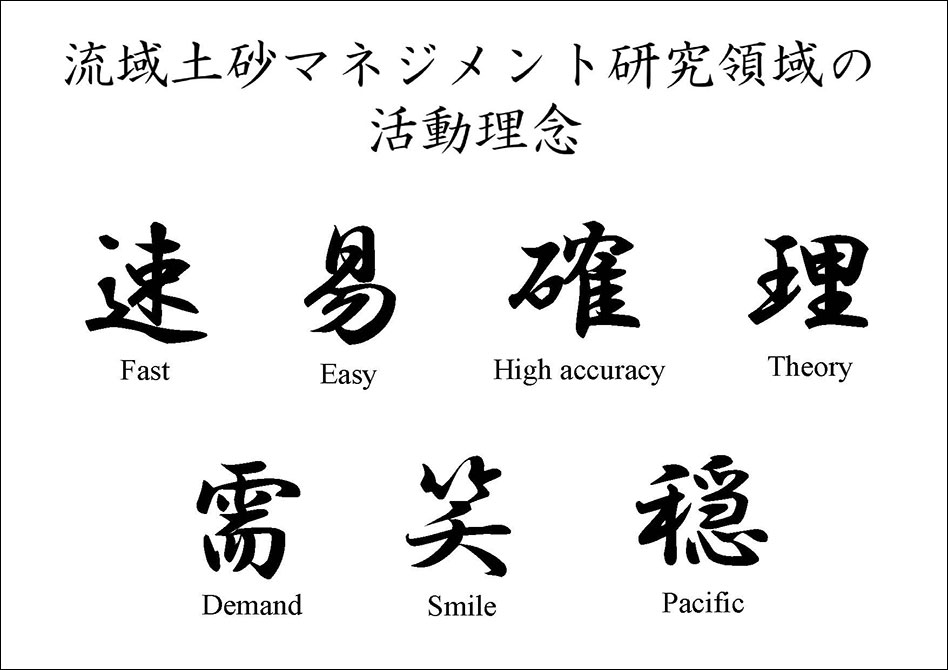
TAKEBAYASHI: At RiSM, we aim to eliminate damage from landslides, and we are developing "watershed sediment management technologies" that can be put to practical use in society, including improving numerical simulation technology for debris flows, developing technology to predict the occurrence of landslides, and developing effective evacuation methods for landslides. The seven kanji characters represent the research philosophy that RiSM values. Increasing the speed of analysis and other processes increases research efficiency, allowing for more analysis and more time to examine the results. Simple and easy-to-use technologies also make it easier to utilize advanced technologies. We also aim to conduct research that is accurate, based on fundamental principles, and meets the needs of society. We want our research to bring smiles to both researchers and recipients, and to help create aquatic environments where people, animals, and plants can live peacefully.
- Kanji characters allow us to intuitively understand concepts. Specifically, what kind of research are you conducting?
KUWAHARA: Currently, we are considering six research themes, as shown in the table. We will cover everything from mountain catchment areas to river areas, and ultimately estuaries and estuary sandbars.
| 1 | Basin-scale sediment x flood x driftwood dynamics model |
| 2 | Numerical analysis of debris flows and search and rescue support technology |
| 3 | Riverbed variation analysis x Advanced flood prediction technology |
| 4 | Dynamic river management technology |
| 5 | Technology to improve the reliability of warning information ("Doushaburu") |
| 6 | Developed an overseas-specification warning and evacuation service package |
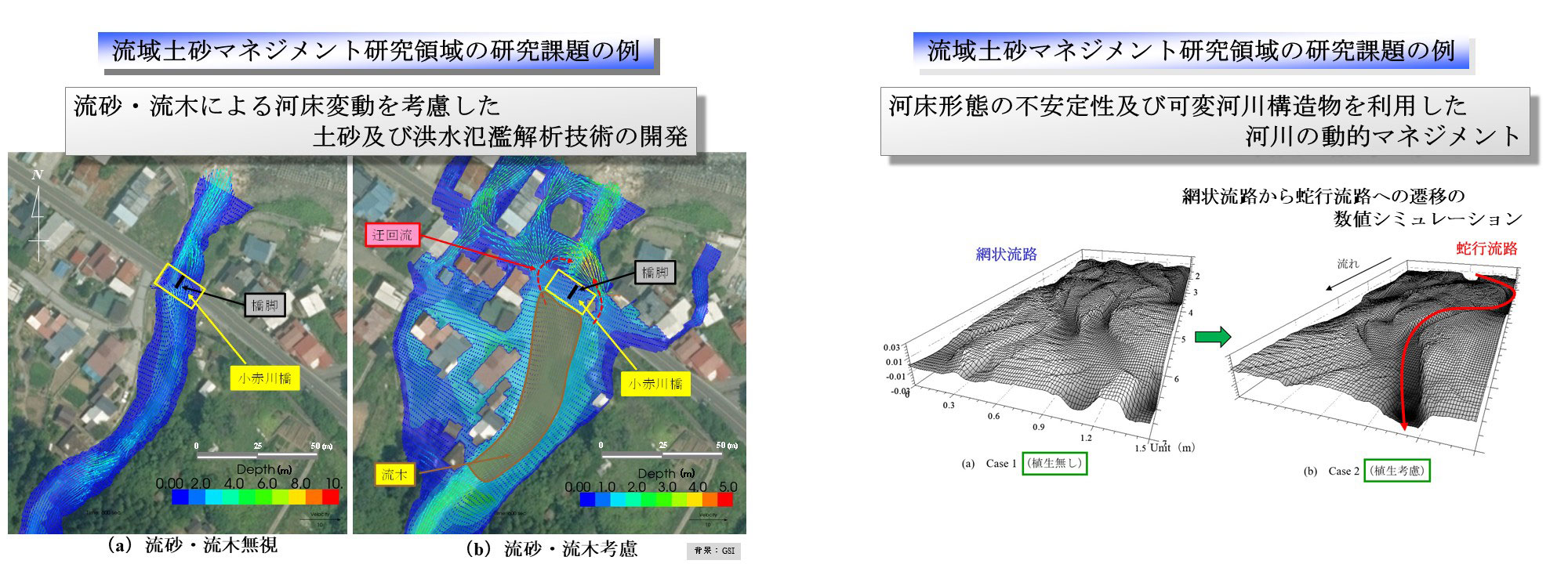
TAKEBAYASHI: As the President OMOTO mentioned earlier, rivers and sabo (erosion control) are currently separate worlds. River flood control plans don't take into account sediment, and they don't consider the possibility of large amounts of sediment flowing into rivers, raising the riverbed and causing flooding. Taking sediment into account is a key focus of our research. This allows us to determine where and how much flooding will occur, and even how flooding can occur even with low flow rates. Unlike continental rivers in the United States and Europe, Japanese rivers are steep and carry a significant amount of sediment. Therefore, flood control measures for almost all Japanese rivers should take sediment into account. In that sense, I believe RiSM can conduct research that demonstrates new technologies. Furthermore, since many of PACIFIC CONSULTANTS' river engineers understand sediment flow, I think it's easy to get input from them about on-site needs.
KUWAHARA: Speaking from the perspective of someone with long experience in the field as a construction consultant, currently, sediment is not directly taken into consideration in the planning stages of rivers. During the maintenance and management stage, we consider how long it will take for sediment movement to stabilize. Unfortunately, there are very few people who can take a bird's-eye view of sediment movement in the initial stages of river planning, or who are adept at using technical calculation formulas. However, I have experience in understanding what concerns river managers have about sediment, and being asked the same questions over and over again, so I am able to incorporate these on-site needs into research and development. If we can successfully combine engineers who know the field with researchers, I believe we can achieve what Professor TAKEBAYASHI called "changing the world through research and development."
- This research will be in line with actual demand.
TAKEBAYASHIi: First of all, we can reduce flood damage. In December 2024, the Ministry of Land, Infrastructure, Transport and Tourism) announced a key theme of "driftwood," and the Minister stated that hazard maps that take driftwood into account will be developed for small and medium-sized rivers in the future. Current river development is based on the idea that a certain amount of water will flow from upstream and that the river should be large enough to accommodate that amount of water. However, in reality, sediment and driftwood can get caught on bridges, blocking the river channel and causing flooding even when there is little water. Furthermore, regarding debris flows and landslides, nowhere in the world is currently able to understand the flow of debris flows through numerical simulations and then develop countermeasures. Meanwhile, numerical simulation technology for debris flows has made remarkable advances over the past decade, and I believe that, if used properly, it will enable the development of highly efficient and effective countermeasures.
Additionally, landslide warning zones known as yellow zones have been designated, but simulations show that in most places, landslides will not flow in dangerous conditions. Only about 10% of people will need to evacuate to another location, such as a shelter. However, currently, everyone in a yellow zone is ordered to evacuate. Many of the designated areas have residential areas on steep slopes, and evacuating children and the elderly during heavy rain is inherently dangerous. If simulations show that 90% of people can remain in their homes, shelters will not fill up, and the risk of people's health deteriorating in shelters can be significantly reduced.
OMOTO: I would like to see this linked to effective evacuation measures as soon as possible.
TAKEBAYASHI: The designation of landslide warning zones is based on law, so any changes would require legal amendments, which is a significant hurdle. There are also concerns about how much we can trust simulation technology. However, many engineers understand that simulation-based designations are far more accurate than the currently designated landslide warning zones. Therefore, studies are underway to utilize the results of simulations, and simulations are actually being used at the municipal level. There are over 700,000 landslide warning zones throughout Japan. With so many areas, some areas are designated as landslide warning zones in multiple layers, resulting in a very large area overall, making it difficult to secure evacuation sites nearby. Therefore, we are building evacuation shelters even within the warning zones. Simulations show that evacuation sites can be secured by moving only 20 or 30 meters, rather than 500 or 600 meters away. Ministry of Land, Infrastructure, Transport and Tourism has also recognized this as a precedent, so we hope that the national government will move forward in this direction.
HIRAKAWA: One of the areas I'm most excited about in Professor HIRAKAWA's "the world-changing" research is the search and rescue support technology listed as the second item in the research summary. In the current search and rescue situation, when a widespread landslide occurs and people go missing, the Self-Defense Forces and fire departments must rely on a human wave approach to enter the collapsed slopes. This is a harsh environment, requiring risk and relying on experience and intuition. By utilizing the debris flow simulation we're developing with Professor HIRAKAWA, we can narrow down the location of missing people, leading to early detection and a higher chance of saving lives, while also increasing the safety of search and rescue teams. In other words, this could completely transform search and rescue operations at landslide sites in Japan. Being involved in this kind of technology development is rewarding for us and a major motivator for us.
The significance of co-creation between Disaster Prevention Research Institute, Kyoto University and PACIFIC CONSULTANTS
- The birth of RiSM will likely be an opportunity for new collaboration between the Disaster Prevention Research Institute and our company. What expectations do you have for each other?
HIRAKAWA: For us, this will provide more opportunities than ever before to engage in research into new watershed sediment management, combining rivers and sediment. We hope to create many opportunities for employees to consult with RiSM about their technologies. We hope that by seeing firsthand how innovations that change the world through research and development are actually progressing, employees will develop a mindset to take on innovation. Having previously been involved in recovery and reconstruction support for many large-scale disasters, as well as disaster prevention and mitigation measures, I now, as Chief Technical General Manager, aim to develop a disaster resilience concept and realize a "zero outage society." While we must of course aim for zero casualties from natural disasters, we must not halt socioeconomic activity in order to continue our lives and occupations. To achieve this, it is important that not only companies but also industry-academia collaborations like this are crucial. This endowed research sector marks a new step.
TAKEBAYASHI: We would also like to develop technology that engineers can actually use in the field, but we won't know the specific needs until we hear from you all. While there are some things that only researchers in specialized fields can see, it's important to hear your opinions, such as, "No, it's not that easy." I would be happy to discuss and share ideas that no one has yet imagined with everyone at PACIFIC CONSULTANTS. By setting the development of technology that can be used immediately in the field as a research theme, we can quickly change the world for the better. I think that's what we can do together.
OMOTO: We are not limited to erosion control and rivers, but we have a wide range of fields, so we would love to share information and issues from the field. RiSM will start small in a sense, with two professors for three years, but we would like to grow it together with the professors and make it into a research lab that represents Japan.
TAKEBAYASHI: I would like to see the Disaster Prevention Research Institute, PACIFIC CONSULTANTS, as well as the local government and residents, look back in 10 years and say that it was a good idea to establish this endowed research sector.