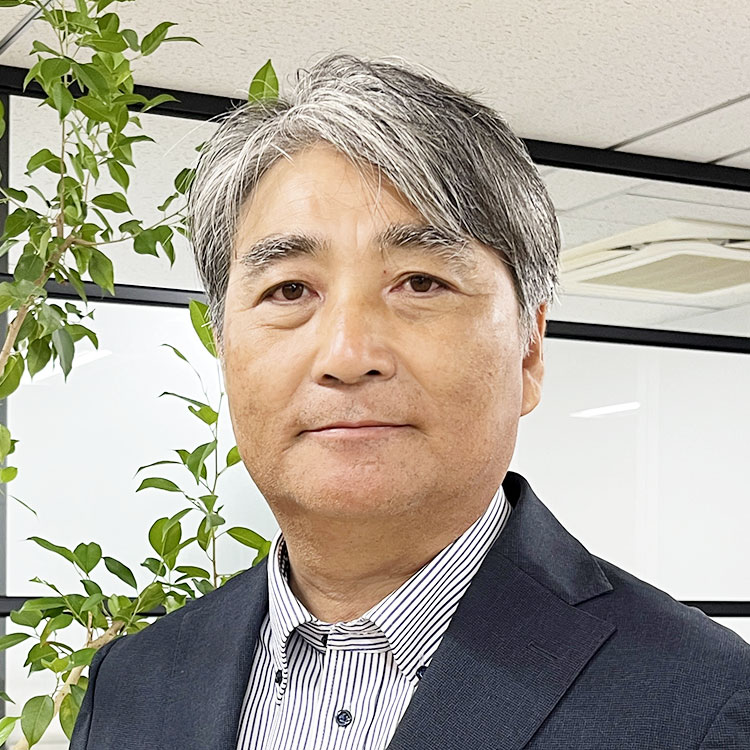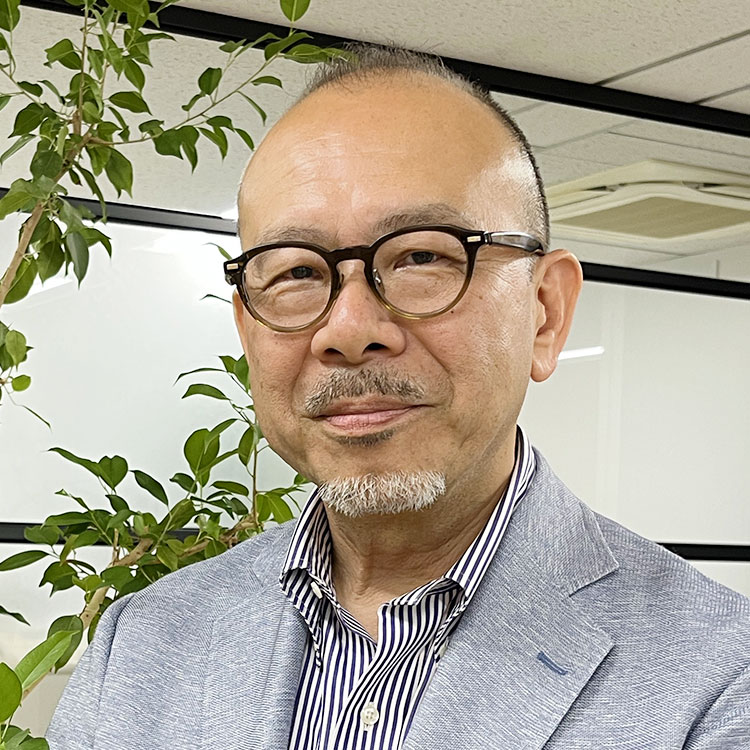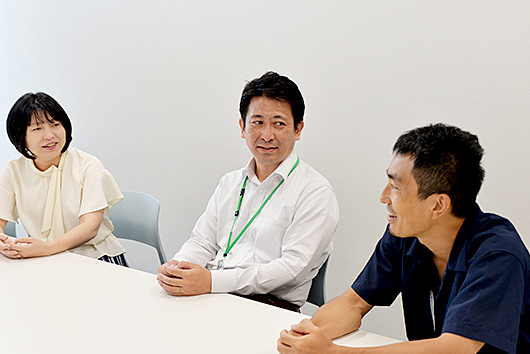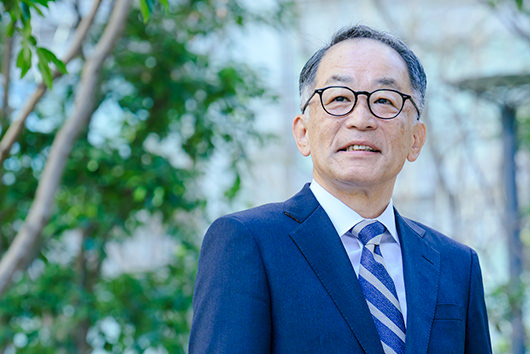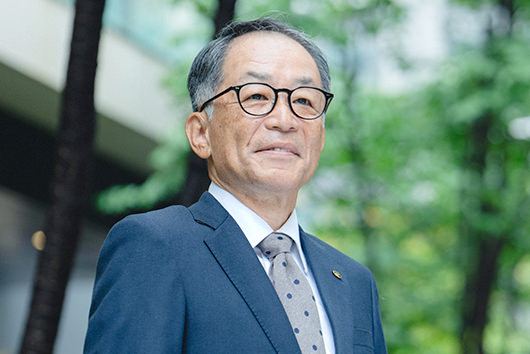

In December 2023, PADECO Co., Ltd. became a member of Pacific Consultants Group. Then, in October 2026, it will relaunch as Pacific Padeco International, a new company responsible for the group's international business while taking over Pacific Consultants' international operations. We spoke with three individuals who have led PADECO for many years—Yojiro Fujiwara, Director / Executive Vice President; Takashi Soma, Director /Managing Executive Officer; and Yohei Soma, Director /Managing Executive Officer—about PADECO's characteristics and strengths. (Positions are as of June 2026)
INDEX
- An open and flat organization
- Based on outcomes, not outputs
- As a member of Pacific Consultants Group
An open and flat organization
—What kind of PADECO's company is? First, please tell us about your company profile
FUJIWARA: PADECO is an international consulting company established in 1983 by the founder, Yuichiro MOTOMURA. The company's name, PADECO, is a combination of the three words "Pan," "Development," and "Consultants," reflecting the desire to become a development consultant that can compete on a global scale. I heard that it started with just two employees in a project in Thailand, but it has expanded its business year by year, and currently has branches in India, Bangladesh, Vietnam, Romania, and Georgia, with 146 employees as of June 2026. It has three subsidiaries: PADECO India, PADECO Poland, and PADECO Ukraine. Its business areas are diverse, and under the Consulting Division, there are four departments: Social Infrastructure Development Dept., Education Development Dept., Economic/Social Development Dept., and Energy Business Dept.
—Have you specialized in education and the socio-economic fields since the company's foundation?
SOMA (Takashi): I don't think so. The founder's idea was to thoroughly consider what would benefit the local people and provide truly valuable things in a way that was appropriate for the local environment. Members who resonated with that idea gradually gathered, and each of them challenged himself/herself to do what they wanted to do. The founder wanted a free and flat organization, so he respected each person's thoughts and individuality. Of the three of us here today, I'm the longest-serving, having joined this company since 2005. I was originally a high school earth science teacher and was interested in education, so after joining the company, I was involved in education projects in Bangladesh for many years. That became PADECO's track record, and the education field became a strength. FUJIWARA also joined in 2010 and has been in charge of many economic/social projects, and SOMA Yohei joined in 2009. He was originally a civil engineer, and his previous workplace was a construction company, so he has been in charge of infrastructure survey, design, and construction projects, which PADECO had not traditionally handled much, and has greatly expanded the business. Not just the three of us, but all employees have been able to work while making use of their interests and areas of expertise, and I think that's what has built up to where we are today.
SOMA (Yohei): That's certainly true. Rather than the company's policies coming first, I think it's the employees' aspirations that created the company as it is today. I joined the company right when we were setting up the infrastructure sector. Because we lacked personnel, we found excellent consultants and consulting firms that were suitable for each project, teamed up with them, and worked on the project while managing them. You could say that PADECO's unique characteristic of selecting the best people from a global talent pool and assigning them to each project was created from that experience.
—I heard that many of you have experience with the Japan Overseas Cooperation Volunteers
FUJIWARA: That's one reason why many of our members have a strong desire to do something for the local community. We have many people who are locally focused and hands-on, and we want to work together with the local people to figure out what would be best for them. When SOMA (Takashi) was working on the Bangladesh project, he spent about 10 months of the year there.
SOMA (Takashi): So for the first 10 years after joining the company, I didn't really know much about it (laughs).
Based on outcomes, not outputs
—Could you tell us about any distinctive features of your projects so far?
FUJIWARA: For example, there was the education-related project in Bangladesh that SOMA (Takashi) mainly worked on. It was the catalyst for greatly expanding our work in that country afterward, and it also marked the beginning of our efforts to focus on education.
SOMA (Takashi): In Bangladesh, the education curriculum is revised every 10 years. Textbooks change accordingly, and teaching methods also change. However, funding and personnel are limited, so it's not possible to train teachers nationwide. That's when I thought about making a TV drama. I prepared several stories about various problems that often occur in schools—for example, a student whose father suddenly disappears and who has to take care of his younger brother and can no longer attend school. It's a "school drama" depicting the growth of a female teacher as she struggles to solve these problems. The goal is to convey in an easy-to-understand way what it means to be a teacher, methods for improving lessons, and an ideal school culture through the episodes. A popular Bangladeshi actress played the teacher, and we also gathered other professional actors. Once the work was finished, we held a preview screening for the Deputy Minister of Education and about 70 managers at Manager level and above. The Deputy Minister was wiping away tears as he watched. Many other people were crying as well. It was decided to broadcast it nationwide on the national television network (BTV), and we heard from teachers who watched the drama that they wanted to become teachers like that.
This was a technical project under JICA's "Elementary School Science and Mathematics Education Strengthening Plan," but the initial Terms of Reference (TOR) did not include drama production. We carefully considered what would resonate most with teachers nationwide, planned the project on-site, and proceeded while modifying the contract terms.
FUJIWARA: We focus not only on the output—the deliverables we provide—but also on the changes and value brought about by those outputs, in other words, the outcomes. For example, one project I was in charge of was this: a KAIZEN project in Argentina to strengthen industrial competitiveness. We worked on spreading Japanese-style management and implementing it in pilot companies, which was highly praised by the Argentine government and adopted as a government policy as a preparatory step for introducing DX (Digital Transformation). Furthermore, we incorporated funding from the Inter-American Development Bank (IDB) into the initiative, and achieved widespread deployment through the formation of a productivity improvement network in 12 South American countries. It developed in a dynamic way that we hadn't initially imagined, but I believe this expansion is also a result of our outcome-based approach.
—I've heard that infrastructure projects are also increasing
SOMA (Yohei): PADECO's history of seriously engaging in infrastructure engineering projects is short, and we don't have much experience. We also have a small number of people. That's why we search for excellent foreign consultants and companies around the world and manage them while advancing projects. Even on large sites, it's common for there to be only one or two Japanese employees, with the rest being a team of foreigners, and this is how PADECO handles its overseas infrastructure projects. You could say that we have no choice but to use foreign staff, but building a team by gathering excellent talent in the field to suit the project is a global standard approach. If we only consider our own resources, there will inevitably be weaknesses and shortcomings.
—The key is choosing the right people and companies, right?
SOMA (Yohei): We put a tremendous amount of energy into that, and we carefully define the working relationship, the chain of command, the scope of responsibility, compensation, and other contractual details. That's what allows us to manage it. We have collaborated with major global companies to undertake the basic design and comprehensive consulting project for Mumbai Metro Line 3 in India, and the comprehensive consulting project for the Mumbai Bay Crossing Bridge. In Eastern Europe, we have also been involved in various projects, such as reconstruction support for Ukraine and the construction of the Bucharest International Airport's access railway in Romania, etc.
As a member of Pacific Consultants Group
—How do you see the synergistic effects of becoming part of Pacific Consultants Group?
FUJIWARA: PACIFIC CONSULTANTS has a strong track record and is a well-known company, especially in Japan domestically. I'm once again struck by the power of its name recognition.
SOMA (Takashi): Unfortunately, PADECO is practically unknown in Japan domestically. However, many people know that projects like the Shibuya redevelopment are the work of PACIFIC CONSULTANTS. This has broadened our reach in sales activities.
SOMA (Yohei): We can introduce ourselves as a company with such a track record, including roads and ports, even overseas, and major overseas companies are impressed. Our position has definitely risen. Internally, we have the reassurance that when we have problems with design or other things, our technical team will respond immediately. We can also promote areas that PADECO hasn't been able to handle before, such as disaster prevention and waste-to-energy generation. However, looking back on the past two and a half years, I feel like we could have done more. I think that's something we'll address with the new company that will start in October.
—I'm looking forward to seeing PACIFIC CONSULTANTS GROUP's future international business development. Thank you very much.