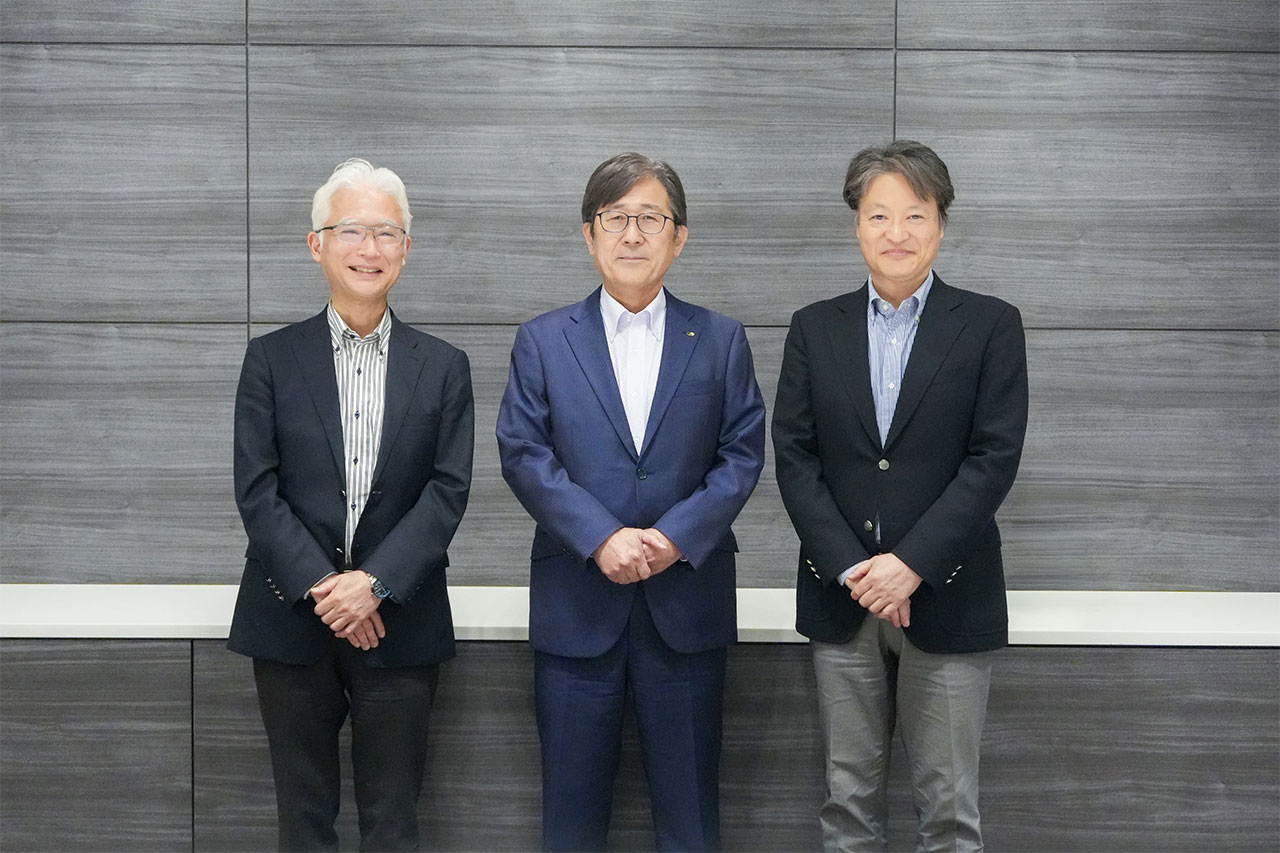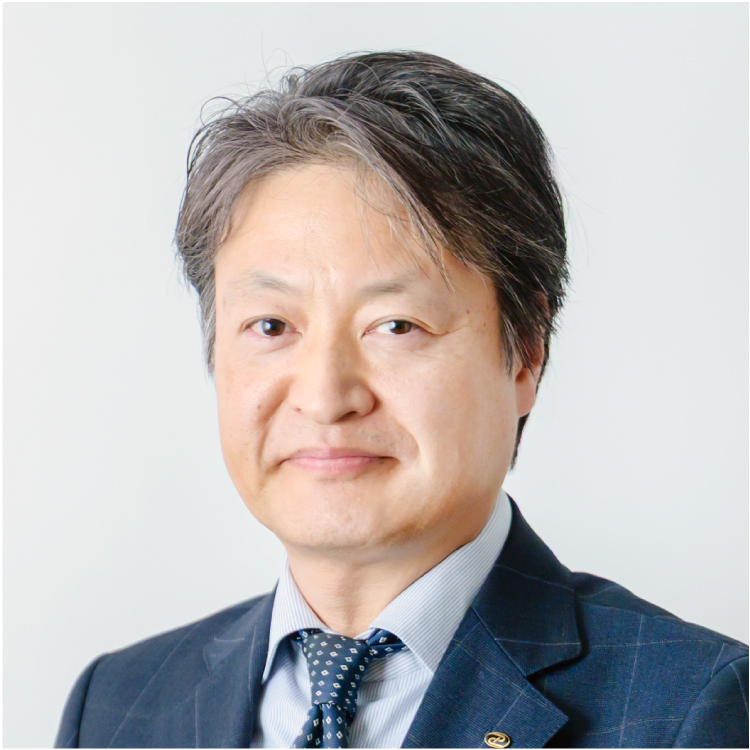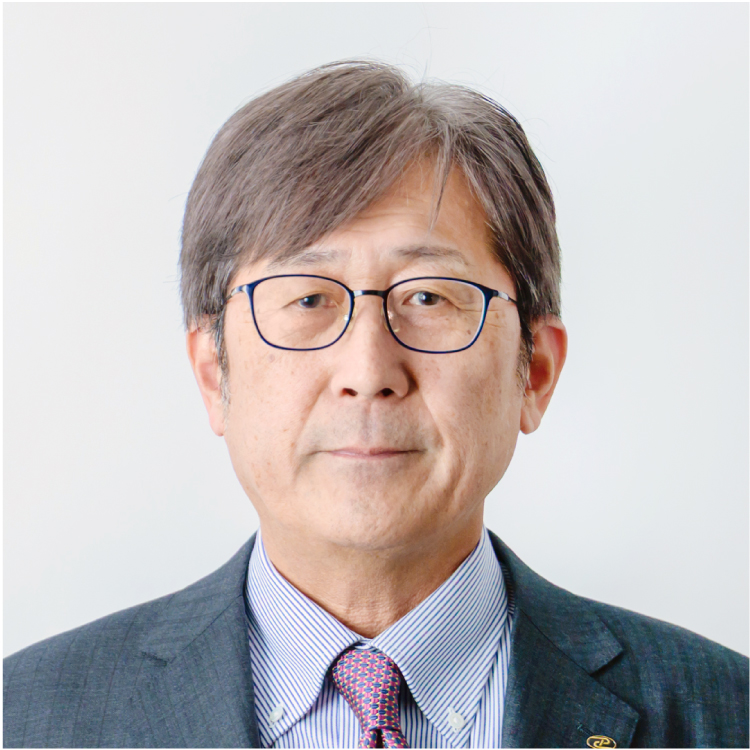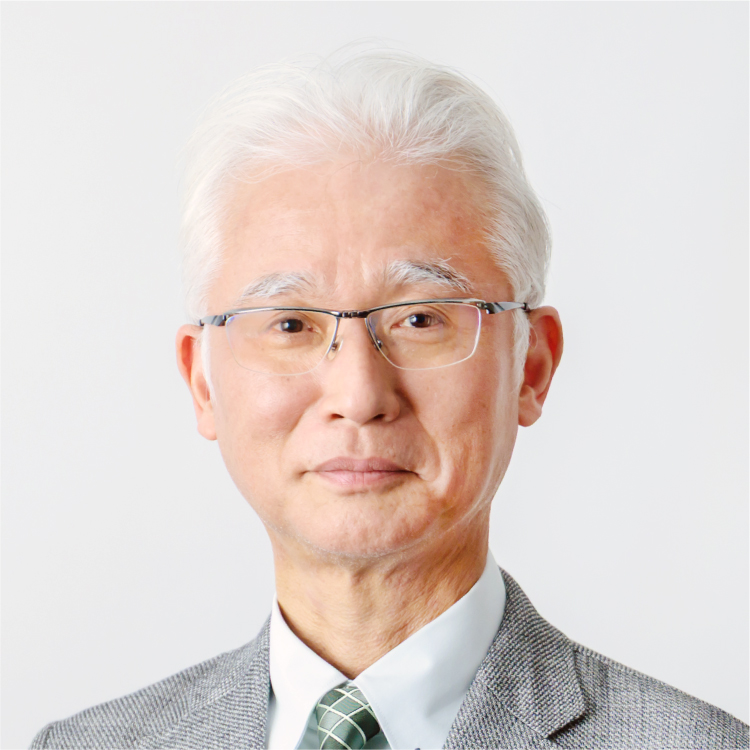

In October 2022, a Chief Technical General Manager System was introduced with the start of the FY72nd. Chief Technical General Manager leads the technical fields of PACIFIC CONSULTANTS and is responsible for formulating the PACIFIC CONSULTANTS's overall technical strategy, promoting orders and creating new businesses by leveraging high-level specialized skills, and fostering an organizational culture that emphasizes quality and technology. We interviewed three Chief Technical General Managers, Ryoji HIRAKAWA, Kenji SASAKI, and Hirokazu ICHIKAWA, about their past efforts and future prospects.
INDEX
- The foundation of trust is quality, and the foundation of quality is technical capability
- "Take a Bird's-Eye View," "Connect," "Try it out"
- As an engineer, we will pioneer a sustainable and resilient society
- The future we envision as Chief Technical General Managers
The foundation of trust is quality, and the foundation of quality is technical capability
—Could you tell us about the role of Chief Technical General Manager and the types of tasks that each person is responsible for?
HIRAKAWA: We believe that technology at our company can be broadly divided into four elements: Quality technology, technology strategy, business creation, and technology diplomacy. Our mission is to enhance the corporate value of our company as a technology company by raising the bar for each of these four elements and simultaneously ensuring that they function in conjunction as a positive cycle.
| Quality Technology | Strengthening preventive maintenance measures, quality technology DX. |
| Technology Strategy | Technology strategy management, improvement of the company's development functions, and strengthening of the technology strategy system. |
| Business Creation | Key theme strategy. |
| Technology Diplomacy | Brand building activities, technical public relations, strengthening relationships with academic societies and other organizations. |
—What exactly are you doing?
SASAKI: Ensuring technical quality and improving technical capabilities are fundamental to our company; without them, we simply cannot be functioned. For consultants, gaining trust is paramount, the foundation of trust is quality, and the foundation of quality is technical capability. PACIFIC CONSULTANTS' origins as a construction consulting company are significantly different from those of our competitors. From its establishment as U.S. Corporation in 1951, we have been a group of consulting engineers, with the mission of proposing projects for the benefit of the nation. Technology has been at the heart of this, and technical capability is the source of our corporate value.
While technology strategy and business creation are, so to speak, "offensive" initiatives, my role is "defensive," and I believe that solidifying this, is essential to supporting the offensive. Naturally, the first thing we must do is eliminate mistakes.
Since becoming the Chief Technical General Manager in the FY72nd, I have been working towards the goal of "Creating an organization that takes pride in delivering error-free deliverables and can autonomously practice quality control." For example, we conduct "Error case study training." We not only explain what kind of error occurred and why, but also what happened as a result of the error and what impact it had both inside and outside the company, thereby reaffirming the importance of quality control.
Furthermore, as part of our quality technology DX initiatives, we are undertaking company-wide efforts to support the development of automated design and labor-saving tools, publish case studies of forms and other materials for improving work efficiency, process management tools, and labor-saving tools, and implement initiatives to make internal know-how searchable and accessible. In addition, we started a Meister system in our FY72nd to ensure that the technical skills, work skills, and human skills that have been passed down in our diverse technological fields are reliably passed on to the next generation, and we are expanding it every fiscal year.
"Take a Bird's-Eye View," "Connect," "Try it out"
―Mr. HIRAKAWA, you're in charge of technology strategy, right?
HIRAKAWA: Yes, I am in a position to lead the company's overall technology development. The budget and number of projects for technology development have been increasing year by year, and in this fiscal year, the 75th, we have allocated a budget of 460 million yen to more than 50 projects. My task is to guide these projects so that they can be successfully completed, and as a Chief Technical General Manager, I also have the role of leading the engineers, so in that respect I have three mottos: "Take a bird's-eye view," "Connect," and "Try it out."
First, it's crucial to "take a bird's-eye view" of technology. While time and space axes immediately come to mind, in technology development, it's also necessary to view things from a comparative perspective. For example, comparing your own company to other companies, construction consultants to other industries, cutting-edge technologies to conventional technologies. As social issues become more complex, solutions cannot be found with only your own company's technology or the technology of a construction consultant alone. Cutting-edge technologies, including AI, are advancing rapidly, but they are not a panacea. Conventional technologies are also effective. We advise on the technologies that should be prioritized, while thoroughly understanding comparative structures, taking a holistic view of technology, and constantly updating our knowledge.
"Connect" means connecting technologies and people. PACIFIC CONSULTANTS' role is to implement technologies in society, so to do that, it is necessary to connect a wide variety of technologies and various stakeholders. We want people to have that mindset, so we also introduce people and technologies in person.
"Try it out" means that the most important thing for social implementation is to try it out in the field. Technical excellence and practical usability are two different things. We encourage early opportunities for proof-of-concept testing, and we support the search for field sites by recommending agile approaches that involve small-scale development and continuous improvement.
ーWhat kind of work are you in charge of, Ms. ICHIKAWA?
ICHIKAWA: I am mainly in charge of business creation. Having previously worked on ITS (Intelligent Transport System) and autonomous driving, I am currently involved in projects that promote national research and development, mainly in mobility and DX.
Specifically, there is an initiative called the Cabinet Office's Strategic Innovation Promotion Program (SIP). This program promotes end-to-end research and development, from basic research to social implementation, on issues that have been set as important for solving Japan's social problems and for the competitiveness of the Japanese economy and industry. It is a program that promotes social implementation from a comprehensive perspective, including not only technological development but also business, systems, social acceptance, and human resources. It started in 2014 and is currently in its third phase with 14 issues set, one of which is "Construction of a Smart Mobility Platform," and I am working to support its management. Amidst a declining population, an aging society, and labor shortages, the problem of transportation gaps are becoming serious not only in rural areas but also in urban areas. On the other hand, tragic traffic accidents in which elementary school children are victims continue to occur, and the theme is how to redesign mobility and how to build a platform to support it so that people can live safely, prosperously, and sustainably.
As an engineer, we will pioneer a sustainable and resilient society
—What are your thoughts on the challenges currently facing technology development and engineers?
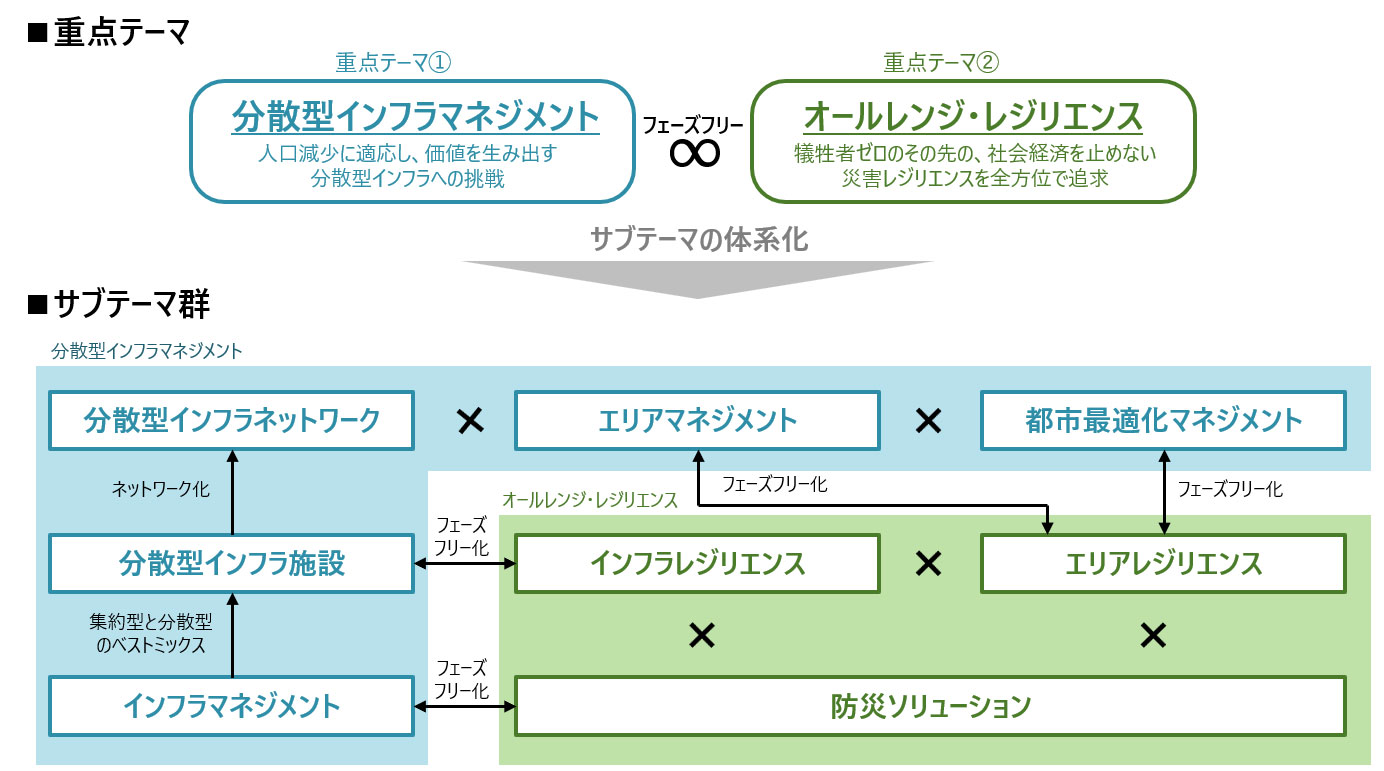
HIRAKAWA: Currently, we are facing a situation where population decline, and increasingly severe disasters are occurring simultaneously, making social issues more complicated. In this context, we believe that the future that our company, a social infrastructure service provider, should aim for is a "Sustainable and Resilient Society." Sustainability is generally thought of as something that occurs in peacetime, such as continuity and efficiency, while resilience is thought of as something that responds to disasters. However, these are now needed simultaneously, regardless of whether it is peacetime or disaster time, and must be connected. One approach to this is phase-free. We want to boldly take on the challenge of realizing a sustainable and disaster-resistant Sustainable and Resilient Society by actively incorporating cutting-edge technologies into the social infrastructure technologies that we have cultivated so far. Specifically, there are two key themes (see diagram below). Furthermore, we have positioned a group of sub-themes under these two, and we are trying to comprehensively advance all existing initiatives and new ones that we will be working on, both internal and external, through All PACIFIC CONSULTANTS. Furthermore, distributed infrastructure management is a concept we jointly proposed with Nikken Sekkei Ltd., and we will continue to strengthen our collaboration with such co-creation partners.
—What other challenges do you see?
SASAKI: Related to mistakes, many cases of discrepancies between the detailed design results and the actual construction site have been pointed out. To resolve this, we need to consider measures to avoid discrepancies on-site, such as conducting multiple joint site surveys with the client, and, instead of doing cost estimation after the design is completed and then proceeding with construction, conducting cost estimation work concurrently with the design to check for any problems with constructability at this stage. Furthermore, since we are working to strengthen our PM/CM capabilities, we would like to consider creating a system in which we can take another step forward to provide support.
ICHIKAWA: Our company has accumulated a vast amount of knowledges and technologies through our past operations, but I believe we haven't always been successful in utilizing it. Considering the projected decline in the number of people with the necessary skills, Mr. SASAKI mentioned initiatives to make it possible to search and refer to the know-how within the company, but I think strengthening the mechanisms for effectively utilizing this knowledge as an organization is an urgent issue. We expect advancements, including the use of AI.
Furthermore, as exemplified by digital twins, there is an accelerating trend towards recreating the physical (real) world in cyberspace using vast amounts of information collected from various sensors, and making decisions based on that data. In this context, the very fabric of society is changing dramatically, with AI performing analysis and processing in place of humans, and the results being used to control the real world through robots and other means. In the future, in a society based on vast amounts of data, I believe there will be a demand for engineers who can connect data with the field and translate that data into actual services that are implemented in society. I sincerely hope that future generations will become such engineers.
—The type of engineer required changes with the times, doesn't it?
HIRAKAWA: I want you to value two things. First, I want you to cultivate the ability to actually move things forward. This means using knowledges and skills appropriately and in a timely manner, and gathering the strengths of people to solve problems. This cannot be done by technology alone, nor can it be done by AI. I believe that it is the human skills of engineers that will carry out the last mile to social implementation. I really want you to become engineers who can accomplish that.
Another key strength is our comprehensive engineering capability. We develop large-scale overall concepts and systematically combine elemental technologies to solve social problems. As I mentioned earlier, fragmented efforts by individual companies or single technologies cannot solve social problems today. I hope that our engineers, with their comprehensive engineering capabilities, will lead diverse collaborations and see projects through to social implementation.
SASAKI: In my new employee training, I first tell them that it's important to "Approach their work sincerely and honestly," "Value independent thinking," and "Work in a way that solves work challenges with ambition and a spirit of inquiry." In addition to these, I emphasize the importance of having the ability to grasp situations that change moment by moment, logical thinking ability which is the source of technical skill, communication skills, and acquiring basic technical skills. However, the most important thing for an engineer is motivation and attitude. Take pride in your own achievements! I want them to have a strong sense of responsibility to check the content themselves in order to achieve this. I want to create a positive cycle where they can engage in autonomous quality control activities, eliminate mistakes, and further improve quality, thereby achieving both technical skill improvement and quality assurance at the same time.
The future we envision as Chief Technical General Managers
—What are your goals going forward as a Chief Technical General Manager?
SASAKI: I feel that people currently working on detailed design are overly preoccupied with the fear of making mistakes, rather than with the sense of fulfillment and accomplishment they feel in their work. I want to create an environment where people can work with more pride, thinking, "I designed this." The world is becoming increasingly software-driven, but nothing can be created without detailed design. I want to create a company where the people involved in this can work with pride and a sense of accomplishment.
ICHIKAWA: As symbolized by SIP, future businesses will no longer be completed by a single company alone, but will be built by multiple companies and organizations bringing together their areas of expertise. HIRAKAWA mentioned the keyword "Connect," and I also feel its importance. By connecting technologies from various fields within the company, and further connecting with external partners, new value that leads to social implementation will be created, and our business model will also expand. Based on our strength in comprehensive engineering capabilities, we hope to evolve like an amoeba, freely changing shape and expanding our connections both internally and externally. In that context, I would like to take on the role of connecting different technologies and entities and making them viable as businesses.
HIRAKAWA: I envision our company taking the lead in realizing the aforementioned Sustainable and Resilient Society. As a Chief Technical General Manager, I want to lead efforts to advance our technology and enhance our brand power under this big picture. Our company also has many Professional Engineer (PE) from a wide range of fields, and we are working on diverse projects. We have an environment where we can learn from and inspire each other, and hone our skills. Furthermore, I want to expand and enrich this environment both inside and outside the company, and support the growth of each individual. The Disaster Prevention Agency is scheduled to be established in November 2026, and in the fall of 2027, the Asia-Pacific Ministerial Conference on Disaster Risk Reduction (APMCDRR) will be held in Sendai, bringing together ministers in charge of disaster risk reduction from approximately 60 countries in the Asia-Pacific region. We will communicate to the world what roles that PACIFIC CONSULTANTS will play in realizing a Sustainable and Resilient Society, along with the existence of our excellent technology and engineers.