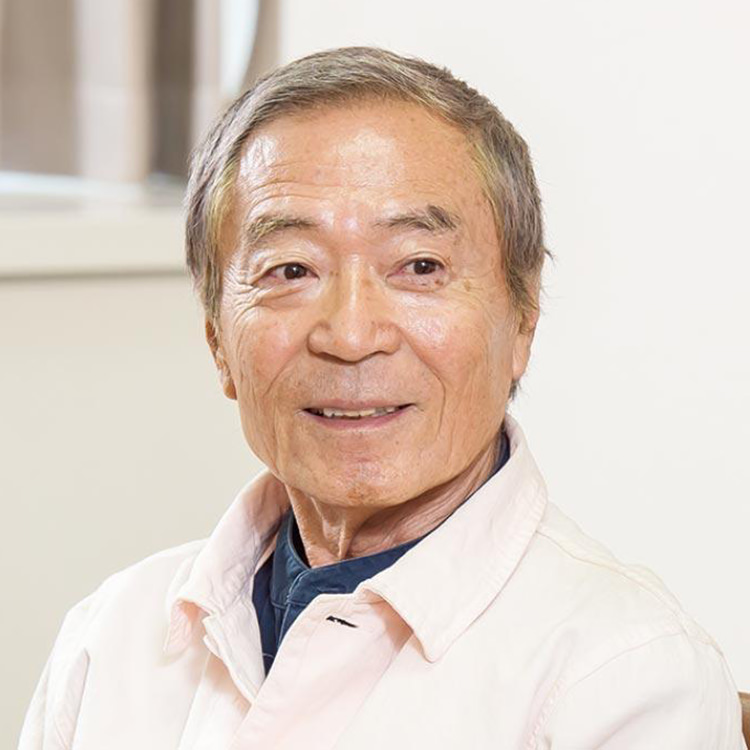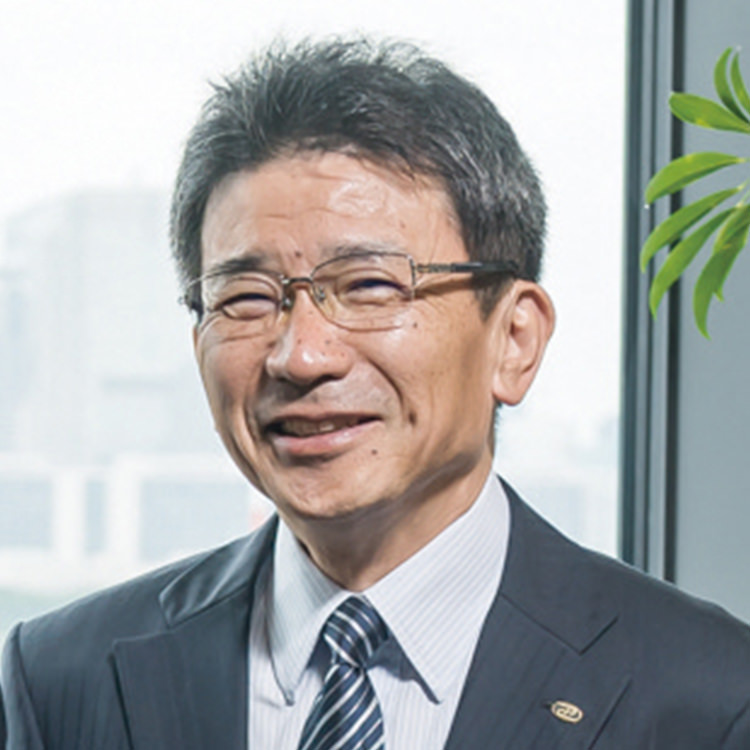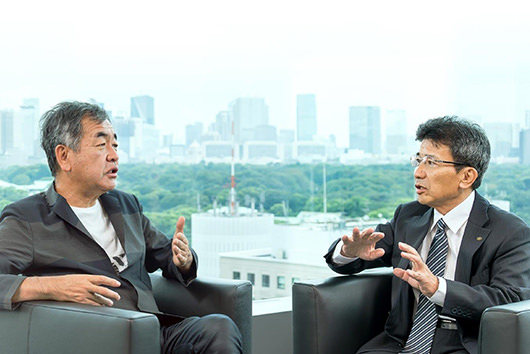

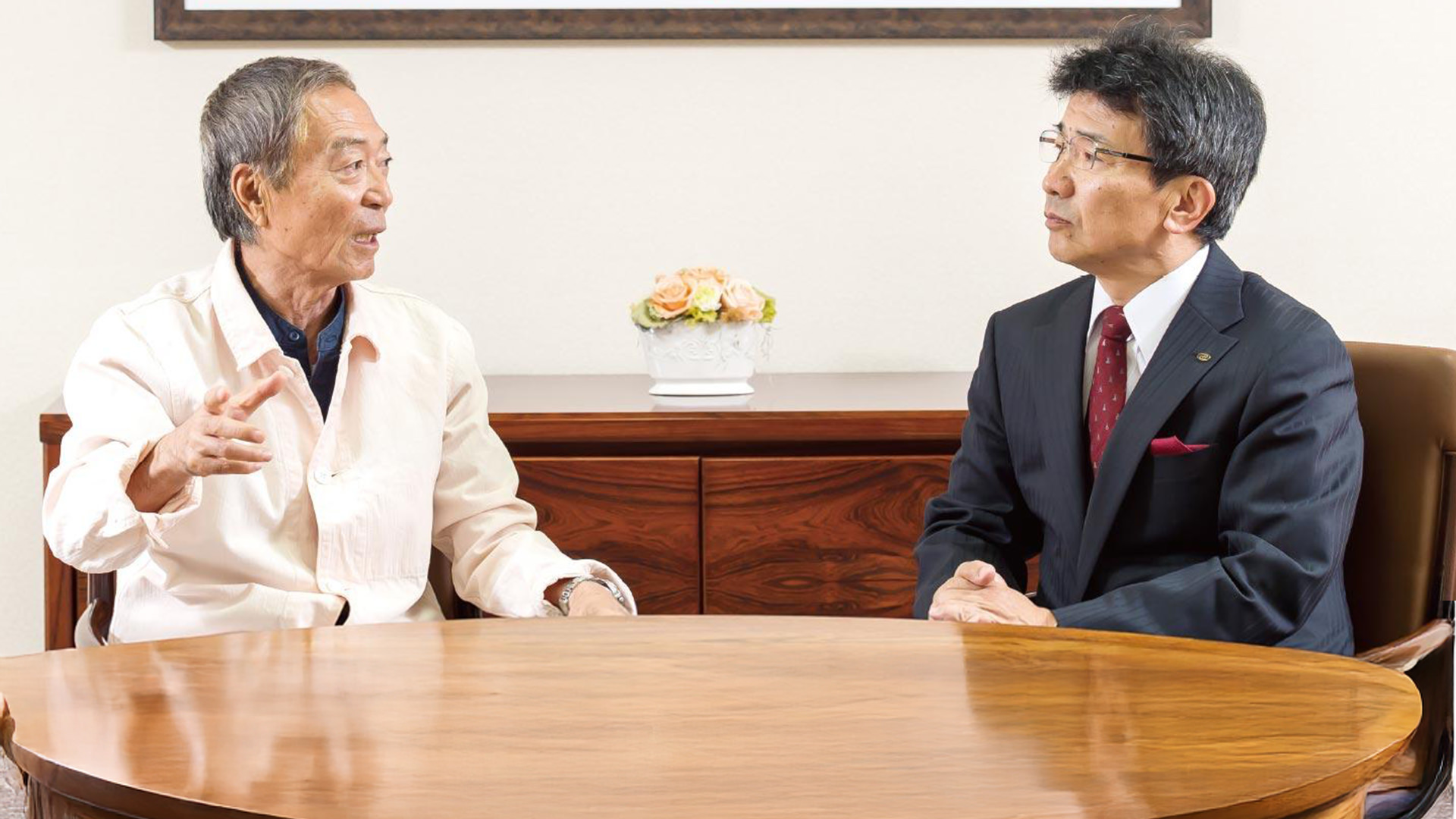
The relationship between photographer Shinpei ASAI and PACIFIC CONSULTANTS began with their shared involvement in the reconstruction efforts in Kamaishi City, Iwate Prefecture. Despite their differing positions as a company and an artist, they shared a common interest in the recovery of Tohoku and the revitalization of regional areas throughout Japan. What insights emerged from this conversation about the future of their collaboration…?
INDEX
- To enhance our ability to communicate with local communities for urban development
- The key to community development is understanding the past and creating the future
- Our role as a social service provider
- The know-how gained from regional management can be applied nationwide
To enhance our ability to communicate with local communities for urban development
TAKAKI: Our company has a support agreement with Kamaishi City for coordinating the recovery of local industries after the earthquake. Meanwhile, Mr. ASAI also has a strong interest in the recovery of Kamaishi, a city known for its steelmaking and rugby. Last March, Mr. ASAI visited our company, and we began discussions about collaboration. In May, we held a roundtable discussion with Mr. ASAI, Kamaishi Mayor Takenori NODA, Director SHIGENAGA, and myself. This time, I would like to discuss with Mr. ASAI again, focusing on the recovery of Kamaishi, the future of construction culture in Japan, and the role of construction consulting companies.
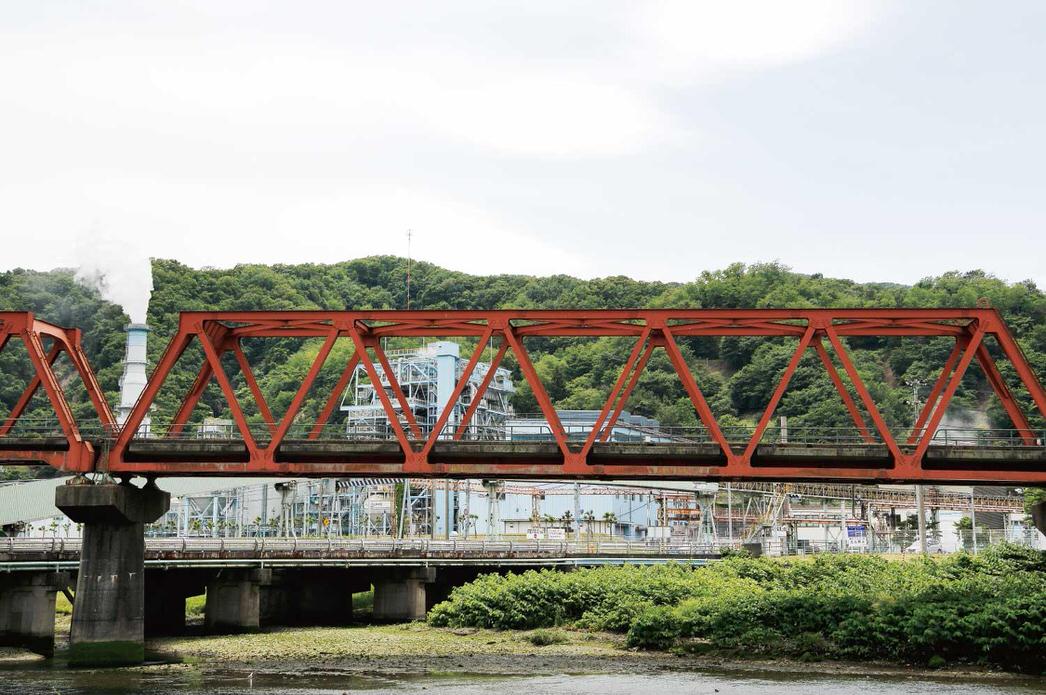
TAKAKI: Our connection with Kamaishi City began when we assisted with a debris removal project after the earthquake as a PMC (Project Management Consulting) provider. The project aimed to recycle an estimated 800,000 tons of earthquake debris as much as possible and transform it into resources. As we progressed with that project, we also became involved in the reconstruction of the city. We are working with the administration and citizens to consider what kind of appeal Kamaishi will offer in the future, how to foster employment and industry, and how to create a sustainable city.
When we consider urban development, rationality is paramount. As it is a public project, costs must be kept down while still producing results. At the same time, since it is not a project for one person but for citizens with diverse interests, it is also important to ensure diversity in the plan. However, what I have been thinking strongly about lately is whether that alone is enough.
I feel that sensitivity is essential for community development. Without sensitivity, community development becomes bland. When the people living in that town have happy expressions on their faces, that attracts people from outside. I think there are things that cannot be seen in numbers. That's why I wanted to talk to photographer ASAI, who places great importance on sensitivity in his daily work.
ASAI: I also visited Kamaishi and several other disaster-stricken areas, and while the effects of the earthquake cast a shadow over each town, I could also sense the energy of people trying to recover. The earthquake was a tragedy, but we don't necessarily have to think of it only negatively; we can use it as an opportunity to create new towns. I think debris removal was an unavoidable task in order to move forward in a positive direction.
Let's start by looking at the current situation as frankly and objectively as possible, without adding any bias, and seeing both the good and the bad. When I talk to the people of Kamaishi, they all agree on the desire for recovery, but their images of recovery are different. There are diverse realities. To use a rugby analogy, everything isn't perfectly prepared, but the kickoff whistle has already blown. The players are running, unsure of what formation to use or who to pass to. I believe that excellent leaders will emerge from among the citizens as they confront this chaotic reality, and I think it's very good that PACIFIC CONSULTANTS is helping them in that process.
Fortunately, Kamaishi has symbolic images associated with steelmaking, rugby, and being a good port in Tohoku, making it a city known throughout Japan. If these are utilized effectively, they should become symbols of reconstruction.
The key to community development is understanding the past and creating the future
I want to find the process of people becoming happy within the process of Kamaishi recovering from the tragic disaster. — ASAI
TAKAKI: I think the construction of the stadium for the Rugby World Cup 2019 will also greatly boost the recovery efforts. Recovery takes many years. What's important is that people from outside the region take an interest in and watch the plans and progress. Knowing that people from outside the region are paying attention and have expectations will encourage those directly involved in the recovery, and above all, it will make being involved in the recovery project enjoyable. In that sense, I think that if Mr. ASAI continues to share his vision of Kamaishi through his photographs, we can sustain the interest of people all over Japan, and even the world.
ASAI: In this earthquake, I didn't do any work that involved documenting the aftermath. A vast amount of photographic evidence was left behind, so there was no need for me to go. However, I accepted this collaboration with PACIFIC CONSULTANTS because I felt it was about thinking about the future, rather than documenting the aftermath and the devastation.
Understanding the past and creating the future – I believe this is a crucial point in community development. Community development not just for ourselves, but for our children, grandchildren, and future generations. Creating a community while imagining how wonderful it would be to have such a place in the future. Restoring infrastructure such as roads and buildings is important, but if that's all there is to it, it's merely economic recovery, and that alone won't make people happy. In other words, I believe that infrastructure development needs to lead to the creation of a new culture.
One of the moments I find most rewarding while traveling the world is when I encounter the smiles of children playing in a back alley. The happiness of the people who live there is what brings the most comfort to a traveler. It may seem like a small thing, but caring about the happiness of future residents becomes an important concept, even when building a single facility. In the process of Kamaishi recovering step by step from the tragic disaster, I want to find the process of human recovery, the process of people becoming happy again.
Our role as a social service provider
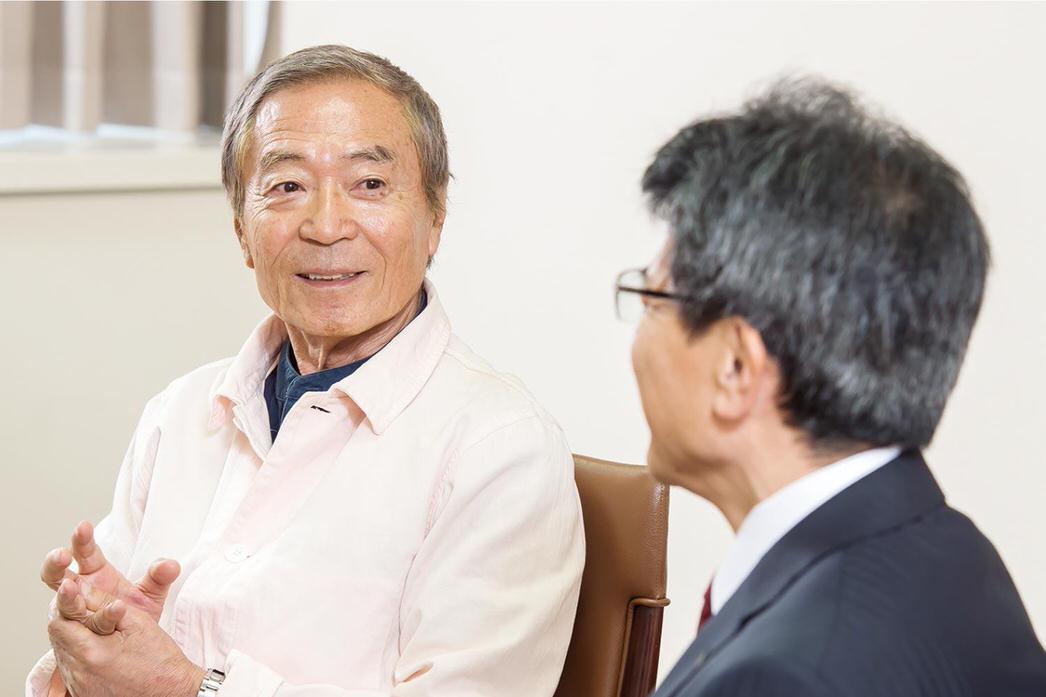
TAKAKI: Mr. ASAI's words are very encouraging. In our medium-term management plan, we include the message, "PACIFIC CONSULTANTS will always be there to guide you through the changes in society." We also express our future direction as a company with the terms "Future Producer" and "Social Service Provider."
Our company was born in the immediate aftermath of the war, amidst the challenges of rebuilding Japan, which had been reduced to rubble. While our business has primarily focused on constructing structures and infrastructure, we have always prided ourselves on building the foundation for providing social services. However, we've recently come to strongly believe that simply constructing civil engineering structures isn't enough for community development. We believe that in the coming era, construction consultants cannot adequately fulfill their roles unless they consider how to realize social services such as energy and water supply, maintenance of public facilities, and education and healthcare. Therefore, we have decided to become a social service provider directly involved in regional revitalization, and we are currently accumulating the necessary expertise.
Even when it comes to something as simple as the new rugby stadium in Kamaishi, there are various discussions about whether a multi-purpose stadium or a dedicated stadium would be better. As one of the stakeholders, we want to be involved in these discussions from the perspective of creating the future culture of Kamaishi, and we want to move the plan forward in a responsible position.
ASAI: I'm against multi-purpose stadiums (laughs). While it might seem rational to have a stadium that can be used for anything, in the long run, it won't contribute to the promotion of sports. I think Japan needs to learn more about the European model of sports management, where dedicated stadiums are supported by citizen organizations like sports clubs. Instead of starting out with a stadium that can host rugby, track and field events, and concerts, we should think in the opposite direction: It's precisely because it's a rugby-dedicated stadium that the world can be proud of and that the citizens love that people will be so enthusiastic when a concert is held there. I believe the construction of the rugby stadium in Kamaishi will be a symbolic place for how we create a relationship between sports and citizens.
The know-how gained from regional management can be applied nationwide
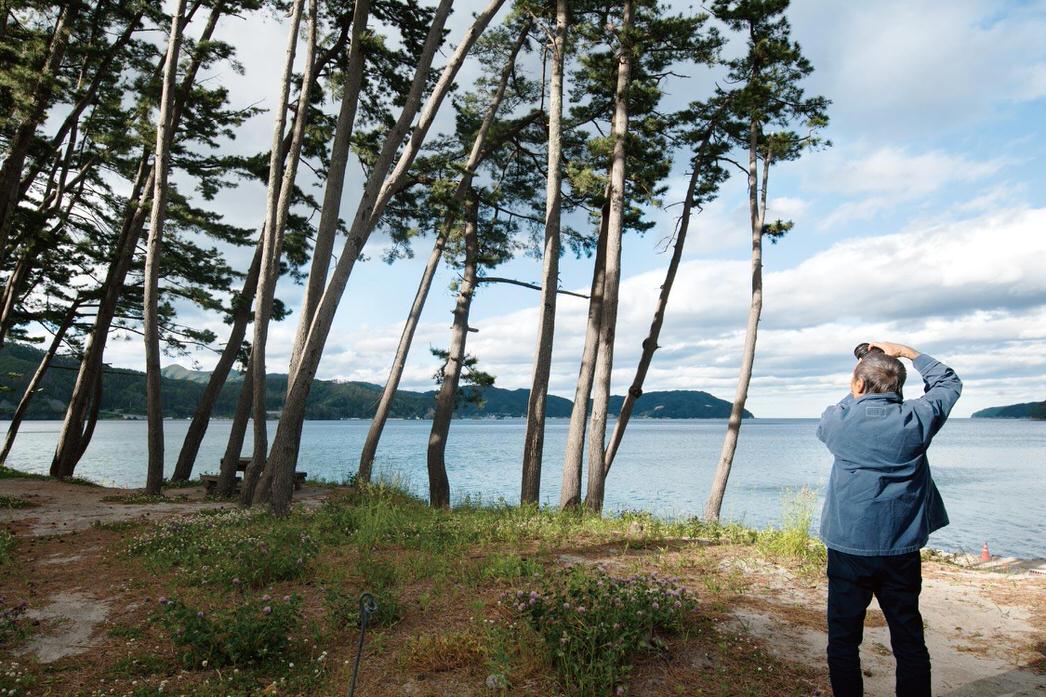
TAKAKI: When the Great Hanshin-Awaji Earthquake struck, I, as an engineer, was deeply shocked. It was as if the earthquake had swept away everything we had been working on. I initially felt the same way about Great East Japan Earthquake, but as I became more involved, I began to think more positively about what we could do to help this town.
Even before the earthquake, Kamaishi faced various problems such as population outflow, an aging population, and the decline of its shopping district. I now believe that reconstruction is also about managing the future of the region.
Of course, this is not a job that we can do alone. We will divide the roles with the local government and proceed as a project, collaborating with other companies. The challenges of population decline, the decline of shopping districts, and the decline of local industries are not unique to Kamaishi, nor are they limited to disaster-stricken areas; regions throughout Japan face similar problems. We believe that by acquiring know-how in regional management through this project in Kamaishi, we can be of service to other regions.
To revitalize a region, it's essential to possess not only the economic rationality of a company and the logic of an engineer, but also the sensibility of an artist. Speaking with Mr. ASAI again, I was deeply impressed by the unique perspective of an artist. I would definitely like to continue learning from him.
ASAI: I wasn't aware that PACIFIC CONSULTANTS was a company that was involved in Japan's post-war reconstruction. I knew that general contractors and construction companies were involved in building buildings and creating towns, but I only learned through this collaboration that the role of construction consultants is actually very important.
Pacific Consultants is a company that has played a vital role in shaping Japanese culture through post-war reconstruction. Some people are calling the Great Great East Japan Earthquake a second post-war period, and I agree that it presents an opportunity to significantly change the way Japanese culture has evolved since the Meiji era. The earthquake has meaning precisely because society is undergoing such major changes for the future. It is a pleasure to be able to offer even a small amount of assistance at such a time.
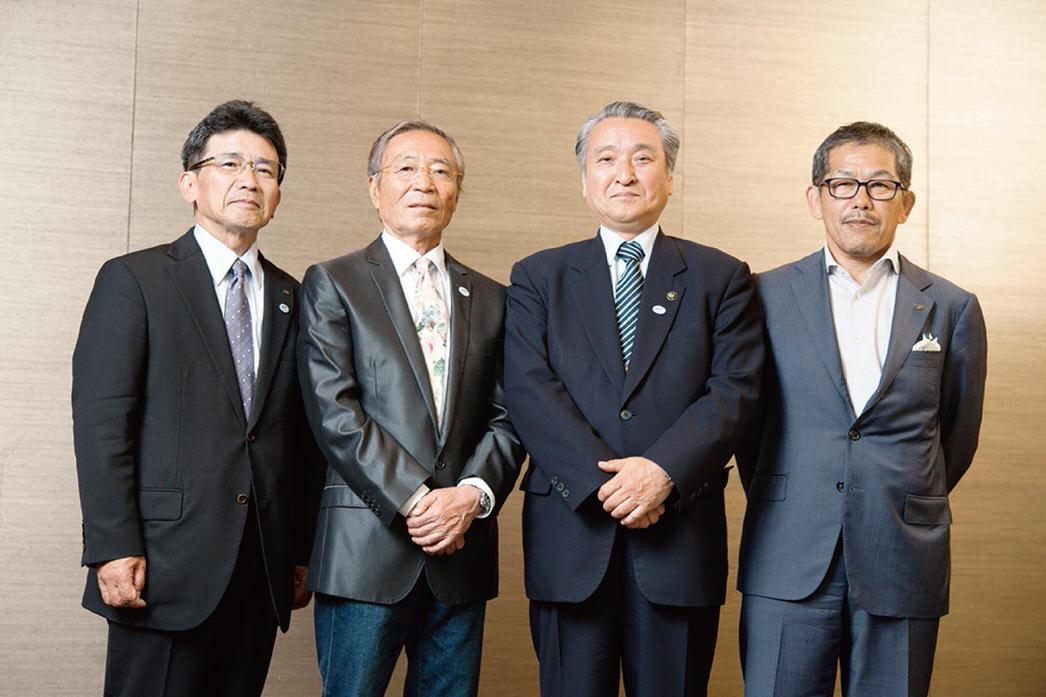
The roundtable discussion, which centered with Kamaishi Mayor Takenori NODA, who is working on the city's reconstruction, was attended by photographer Shinpei ASAI and President TAKAKI of PACIFIC CONSULTANTS and Director Tomoyuki SHIGENAGA.
Regarding the efforts since the disaster, the mayor said, "We have been working to turn this crisis into an opportunity, with recovery plans, breakwaters, and seawalls, aiming to make Kamaishi a new city." Mr. ASAI pointed out that "It is important to send a message about the kind of city we should aim to be." President TAKAKI raised the issue that "A system is needed to keep Kamaishi in the spotlight," and expressed his determination to continue efforts toward further recovery.