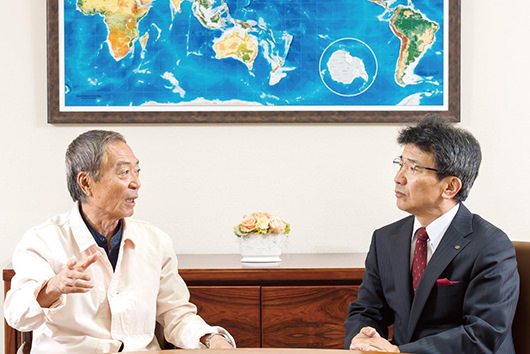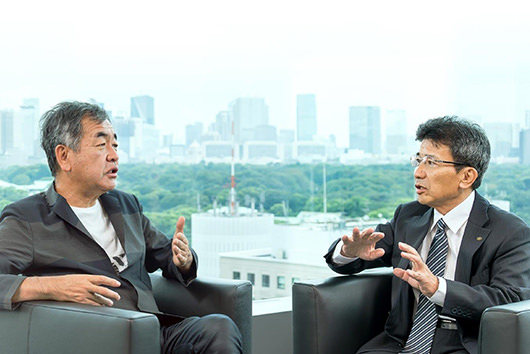

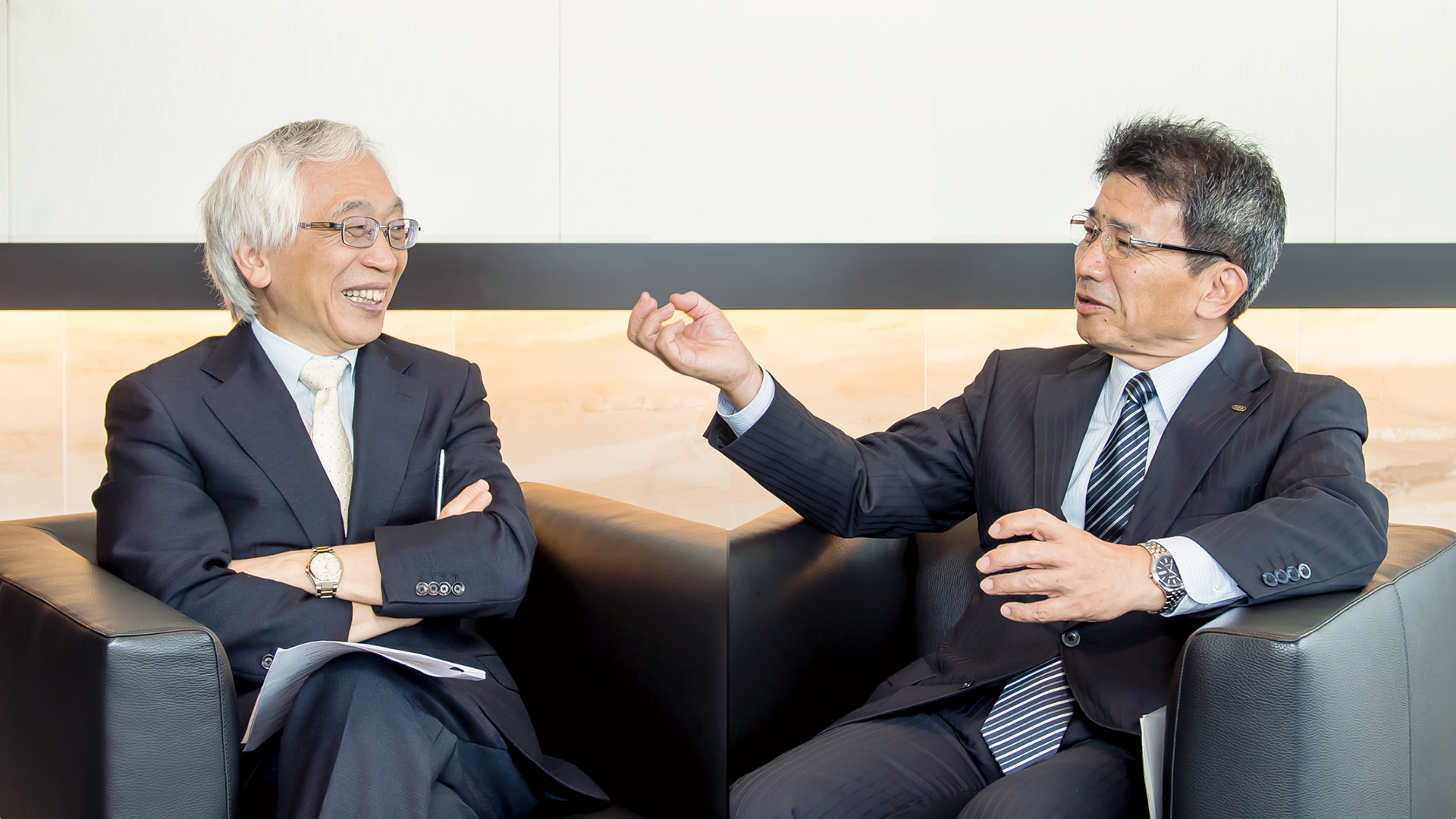
PACIFIC CONSULTANTS, a pioneer in the industry, is committed to promoting work-life balance for its employees and has adopted diversity management as its long-term vision. Professor Hiroki SATO of Chuo University, Graduate School and President Shigenori TAKAKI discussed their efforts and the challenges ahead.
INDEX
- Can new value be created with only "male civil engineering employees"?
- The relationship between work-life balance and diversity
- In diversity, a corporate philosophy that unites employees along with diversity is important
- Dispelling the misconception that "it's impossible for us" or "it's impossible in this industry"
Can new value be created with only "male civil engineering employees"?
TAKAKI: Originally, our company was responsible for infrastructure development in public works such as highway and Shinkansen construction. Our workforce consisted mostly of men, graduate school graduates, and civil engineering graduates, and there was a culture where long working hours were commonplace in order to achieve high-quality work within limited deadlines. This was common in the industry at the time.
However, we never thought things could stay the way they were. In 2009, we began working to improve long working hours in order to protect the health of our employees, and we also became interested in work-life balance (WLB). Fortunately, in 2010, we were selected by the Tokyo Metropolitan Government for the "Tokyo Model" project for work style reform, and with the support of the metropolitan government, we were able to create a foundation for work style reform and WLB promotion.
These efforts are still ongoing. In particular, in recent years, we have come to believe that it is necessary to accept diverse talent and embrace diverse expertise, values, and opinions when considering future business development and growth.
This stemmed from a sense of crisis: when developing infrastructure projects, is it still sufficient to rely solely on the perspective of male civil engineers? We felt that unless people with diverse values and sensibilities participate and provide new value, we might not be accepted by the local community.
Diversity management is one of the two pillars of our "Long-Term Vision 2030," and we position it as a foundation for "providing innovative value to society." To achieve this, we established the Diversity Promotion Office in 2013 and formulated the "Diversity & Inclusion Promotion Policy" in 2015. Currently, we have established working groups within each department and are actively working to promote it.
SATO: At the Graduate School of Strategic Management at Chuo University, where I work, the "Work-Life Balance & Diversity Promotion Research Project" is now in its ninth year. We are conducting joint research with multiple universities and research institutions, as well as 31 private companies, including PACIFIC CONSULTANTS, on topics such as the relationship between work-life balance promotion, diversity management, and working styles. What makes this project unique is that we discuss the challenges that companies currently face with researchers, build up evidence, and then make recommendations for solving those challenges.
Beyond simply addressing the issue of long working hours, we have been disseminating information at an early stage, even before the public became interested, on issues such as balancing work and caregiving, supporting and utilizing women's work-life balance, and reconsidering transfer policies. In that sense, our research projects have definitely yielded results, as we were able to anticipate these issues.
The relationship between work-life balance and diversity
TAKAKI: The name of the study group includes both WLB and diversity. Within the company, promoting WLB is easy to understand and its necessity is well grasped. However, when it comes to diversity, even if we say that it will enable diverse talent to demonstrate their abilities and thrive, I feel that it's often difficult to visualize concrete actions that can be taken.
The essence of work style reform is for each individual to make effective use of their time - SATO
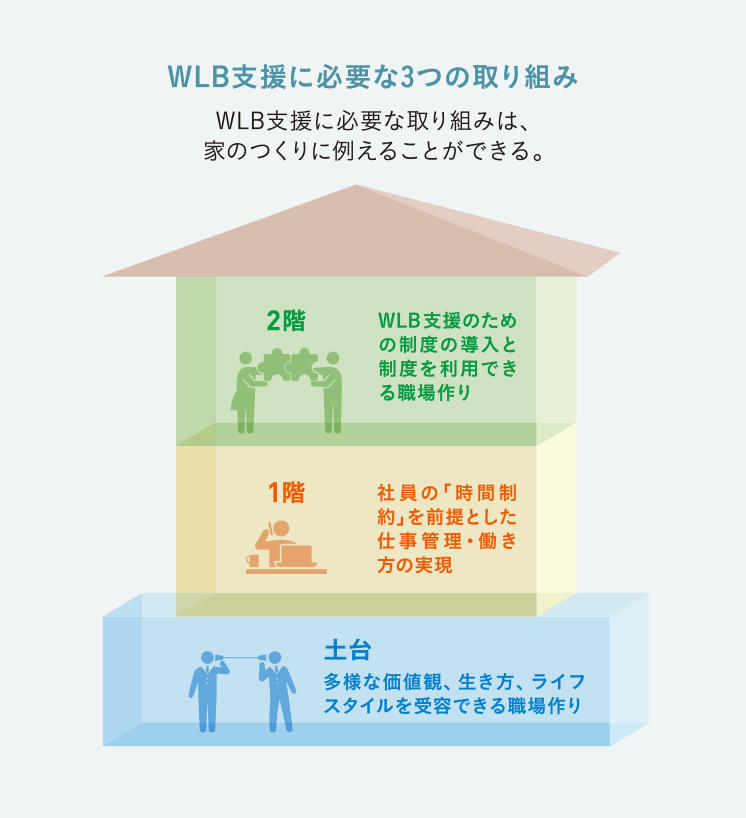
SATO: In Japanese companies up until now, the only work option was to work full-time and not mind working overtime. However, employees can't always work that way. What happens when they have children? What happens when a parent falls ill? Even if someone can't work "full-time + overtime," if they have the ability, we want to actively recognize them as a member of the company and bring out their abilities. That's the basic idea behind WLB.
Furthermore, work-life balance (WLB) must change the way we work. Lately, there's been a tendency to focus solely on reducing overtime, but that doesn't mean that if a workplace has no overtime, then work-style reform is unnecessary. The essence of work-style reform is for each individual to use their time effectively. Reducing overtime is only possible if there's a strong awareness of time management in the workplace, so I don't think we should get the order reversed.
To establish work-life balance (WLB) within a company, an understanding of diversity is essential. This means valuing and utilizing individuals who are relevant to the company's operations, regardless of gender, nationality, or values. In other words, it's about acknowledging the differences of each individual. In this sense, WLB is included within the broader concept of diversity.
I want people to cherish their "life" outside of work, rather than being confined to the office. — TAKAKI
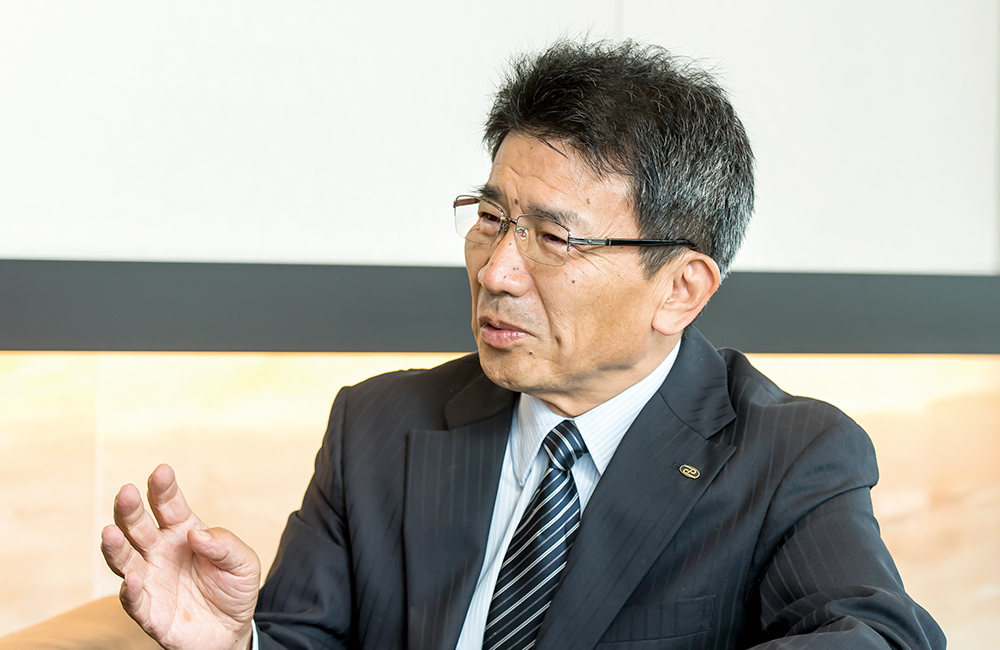
TAKAKI: As a manager, I believe that while efficient use of working hours through work-life balance is important, I also want employees to value their "life" time after work. Instead of confining themselves to the company, I want them to actively participate in local community events, housework, and childcare, so that they can take an interest in what society is asking for, what needs exist, and where and what kind of technological development is taking place. Otherwise, I wouldn't be able to do my job as a social producer and consultant.
SATO: When you try to promote work-life balance, about 30% of people will inevitably say, "I like my job, so the way I work now is fine. Why do I need to go home early?" At first, when they were told to go home early, everyone went to bars (laughs). But eventually, they got tired of bars and gradually started to engage in self-improvement and self-investment. The CEO of a major securities company told me that as they promoted work-life balance, their employees started to engage in self-improvement, and now that company has the highest rate of employees holding necessary qualifications in the industry.
I teach at a business school for working professionals, and about 20-30% of my students haven't told their bosses that they're attending graduate school. What they're studying now will eventually be useful in their work at the company. However, they worry that their bosses won't be happy about it. But we need a shift in thinking that we should praise such employees, and that will be a positive thing for the company.
Being able to do the job is, of course, a given. But beyond that, what happens after you've secured the job is also important. Companies must send the message that they value employees who can demonstrate their abilities in that area as well.
In diversity, a corporate philosophy that unites employees along with diversity is important
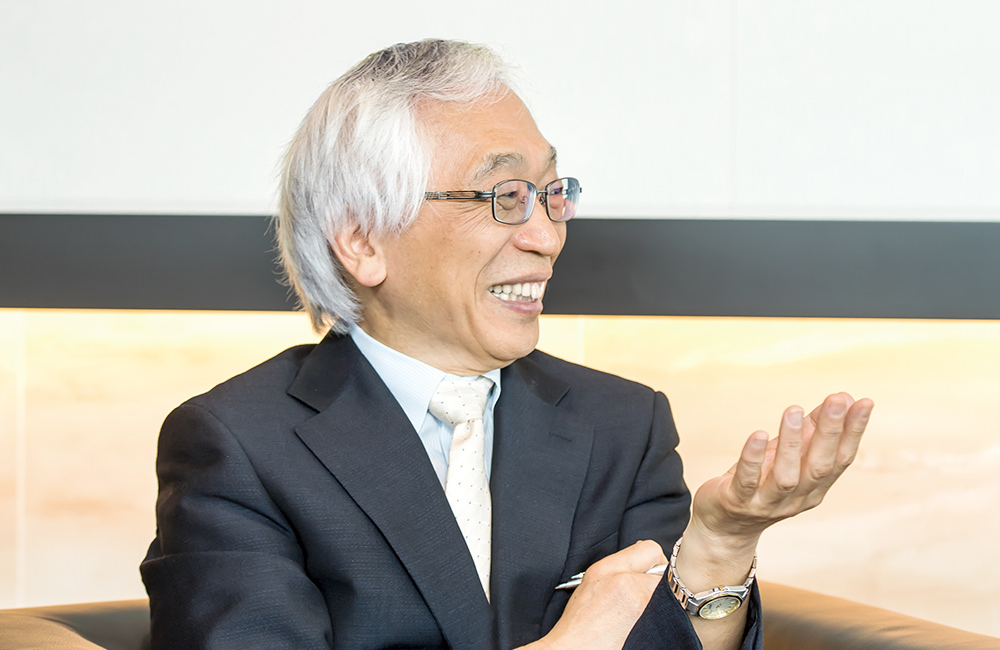
TAKAKI: As a consulting firm, it's natural for each individual to work independently. In other words, we often worked in a "one-man show" style. However, the range of related technologies is expanding, and we are now in an era where we must collaborate with people from various professions. This is why empathy for diversity is essential.
SATO: Diversity management means acknowledging the differences of each individual. However, if that's all there is to it, there's a risk that the company will fall apart. When promoting diversity management, what's also needed is a system to unify employees. That's where the corporate philosophy becomes important. It's something that will never change, no matter how the times change or how the business model changes. It's the fundamental idea of why we conduct our business activities.
Having a strong set of principles allows employees to consider which approach is right when faced with difficult choices regarding business ventures or methods, in light of the company's management philosophy. Ultimately, this strengthens a sense of unity among employees.
TAKAKI: Lately, when I visit branch offices and other places, I make sure to emphasize the importance of management philosophy. By the way, your research group has a history of about 10 years, but how has corporate awareness changed compared to when it was first established?
SATO: In the beginning, the focus was on supporting women in balancing work and family life. Moreover, there was a lot of discussion about how to make use of the systems in place. Gradually, however, the initiatives have shifted to include not only women but also men. Recently, there have been many discussions that lead to a review of the personnel system. For example, the issue of employee transfers. Until now, the system was based on the assumption that employees would silently comply with transfer orders, but as the workforce becomes more diverse, that is no longer feasible. We have no choice but to change to a more flexible personnel system that takes into account the circumstances of each employee.
For example, consider overseas assignments at trading companies. Traditionally, it was common practice to have employees experience overseas work at least once in their early 30s. While this is fine for men, for women, it often coincides with the time when they are likely to get married and raise children. Some companies are shifting to individualized personnel management that is tailored to employees' lifestyles, such as having employees who might experience overseas work earlier, in their 20s. There is also the issue of what to do when a female employee's husband is assigned to work overseas. Some companies have started allowing the employee to take leave only during the period when her husband is working abroad, but these kinds of problems are difficult for a single company to solve on its own.
Dispelling the misconception that "it's impossible for us" or "it's impossible in this industry"
TAKAKI: In 2016, our company was selected as one of the "Top 100 Companies for New Diversity Management" by the Ministry of Economy, Trade and Industry. What aspects of our company were evaluated positively?
SATO: I think the reasons for our success were that we started our efforts earlier than other companies, we are continuing our corporate culture reform, our top management is actively committed to reform, and we are also being recognized for our efforts not only within our own company but also for our outreach to the industry.
As long as employees are suspicious and think, "The top management is talking about work-life balance, but it'll probably just go back to how it was when President changes," the initiative will never take hold. It's also no good as long as people think, "It's structurally impossible in this industry." Even in the system integrator industry, which was once known for its "man-month business" and "3K labor," there are companies that have achieved work-life balance while also improving profit margins by abandoning the "man-month rate" and transforming their business model. It's important to first get rid of the misconception that "we're unique, so it can't be done."
TAKAKI: At our company, too, people used to say that "overtime is an eternal problem," but as long as we kept saying that, the problem wouldn't be solved. The on-site staff and management worked together to take small steps to improve things. And then we spread that to the industry. It was a process of accumulating those efforts. Recently, the construction consulting industry has been implementing "no overtime days" all at once, and efforts to regulate overtime are spreading throughout the industry.
SATO: Working style reform and corporate culture reform are closely linked. It's not something that can be done overnight. We should be prepared for it to take at least 5 or 10 years.
TAKAKI: Finally, let me ask you again: What is necessary to incorporate work-life balance and diversity into key management issues and to achieve them?
SATO: It's about clearly positioning it within the company's management philosophy, and above all, continuing the efforts. I think these efforts must be accompanied by the participation of management and reforms to human resource management methods.
Diversity initiatives don't end simply because a company now employs a diverse workforce. A shift in management thinking is essential to effectively utilize this diverse talent. If the same management methods persist despite the change in personnel, the full potential of that diversity will be lost.
The key to this lies in the mindset of managerial employees at the head of department level and above. When we conduct diversity training for managers, the inevitable response is, "Shouldn't we be doing department manager training first?" (laughs). They say that they can't change unless the top changes.
TAKAKI: It's true that managers are responsible for the organization's results, so it's quite difficult. But these kinds of obstacles can only be overcome over time. In order to achieve work-life balance, it's necessary to reconsider the traditional "uniform way of working" that assumes the typical male full-time employee, and to develop "diverse ways of working" that meet the diverse needs of employees.
Furthermore, there is a need to create new workplaces through reforms in working styles. Talking with you today has helped me to clearly understand the relationship between work-life balance and diversity, and the direction we should take going forward. Thank you very much.