
Go to content
Go to site menu
SCROLL

Moving towards PPP/PFI that Contributes More to Society, Beyond the COVID-19 Pandemic

Post-COVID-19 recommendations: PPP/PFI edition

Society as a whole is facing a major crisis due to the unprecedented force majeure event of the COVID-19 pandemic. The same applies to PPP/PFI projects by PPP, which have become established as the ideal form of sustainable social infrastructure.

The current PPP/PFI framework (business contracts, etc.) lacks clear provisions regarding the spread of viral infections, and the public and private sectors are currently discussing how to address this issue on a project-by-project basis. We believe it is crucial that the impact of the current COVID-19 pandemic does not lead to a decline in the public sector's willingness to promote projects or the private sector's willingness to participate, which could cause PPP/PFI projects in Japan to stagnate.

On the other hand, approximately 100 trillion yen in supplementary budgets have already been allocated for COVID-19 countermeasures, and national and local government debt has expanded significantly. We believe that the importance of PPP/PFI projects, which utilize private sector capabilities, will increase more than ever before in the provision of public services in the future.

PACIFIC CONSULTANTS CO., LTD. has established a working group to discuss the future of PPP/PFI projects in the "with-COVID" and "post-COVID" eras. The core members from this Technical Advisor Service Provider Dept. include Kazuaki MIYAMOTO (Professor Emeritus at Tohoku University and Professor Emeritus at Tokyo City University), our technical advisor, and representatives from our PPP Management Dept., which primarily handles public PPP/PFI advisory services, and our Service Provider Dept., which participates in PPP projects as a private business sectors. Based on the responses and challenges to the COVID-19 pandemic across the country, the group discussed what PPP/PFI projects should be like and compiled their findings into recommendations.
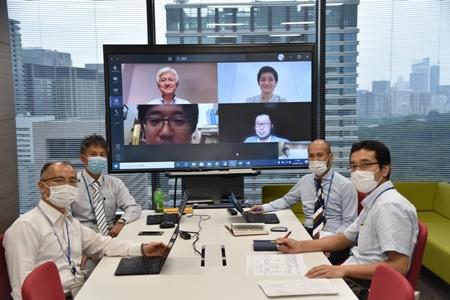
Post-COVID PPP Working Group

We hope this proposal will serve as a starting point for considering the future direction of PPP/PFI projects.

Recommendations on PPP/PFI in the post-COVID-19 society
~ Towards PPP/PFI that contributes more to society, beyond the COVID-19 pandemic ~

<Recommendation 1>
Regarding risk events arising in ongoing PPP/PFI projects, appropriate measures should be taken based on the public-private partnership, and information should be widely disclosed.

<Recommendation 2>
For PPP/PFI projects in the preparation stage, make appropriate decisions regarding project implementation based on the challenges that have become apparent during the COVID-19 pandemic.

<Recommendation 3>
Future PPP/PFI project contracts should include clearer provisions regarding force majeure clauses and similar issues.

<Recommendation 4>
This is an opportunity to re-examine the long-standing challenges and promote PPP/PFI projects with a broader base.

<Recommendation 5>
With an eye on the post-COVID-19 society in which cities and infrastructure will undergo significant changes, we need to evolve PPP/PFI projects into new forms that can better encourage private sector ingenuity and innovation.
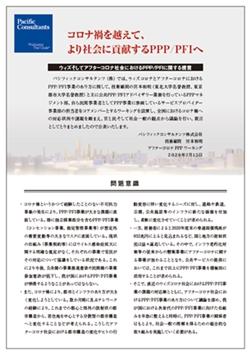
Cover photo: Towards PPP/PFI that contributes more to society, beyond the COVID-19 pandemic.

*The full text of the recommendations can be viewed in the PDF below.
RELATED POSTS

"Prospects for Cities and Regions in the Post-COVID Era" Part 1

On February 18, 2021, Nikken Sekkei and PACIFIC CONSULTANTS co-hosted an event titled "Prospects for Cities and Regions in the Post-COVID Era." The two companies, which have worked together to solve urban challenges in "Transit-Oriented Development (TOD)" projects in central Tokyo, such as around Shibuya Station, presented research and recommendations under the theme of "Transformations Required for Cities and Regions, and the Future of Social Design." This initiative stemmed from an exchange of opinions held last summer by young and mid-career employees of both companies regarding the vision of cities in the post-COVID era, followed by activities conducted by a mixed working team. Here, we present an overview of the presentations given on eight themes, which comprehensively examined cities and regions from a multifaceted perspective, transcending specialized fields such as architecture, urban planning, and social infrastructure, and including energy and smart technologies. 

"Prospects for Cities and Regions in the Post-COVID Era" Part 2

On February 18, 2021, PACIFIC CONSULTANTS and Nikken Sekkei co-hosted an event titled "Prospects for Cities and Regions in the Post-COVID Era." The two companies, which have worked together to solve urban challenges in integrated station-area development (TOD) projects in central Tokyo, such as around Shibuya station, presented directions for the transformations required for cities and regions in the post-COVID era. Part 1 consisted of proposals on "Transformations Required for Cities and Regions, and Future Social Design," based on joint research by young and mid-career working members from PACIFIC CONSULTANTS. Transcending specialized fields such as architecture, urban planning, and social infrastructure, and incorporating multifaceted perspectives including energy and smart technologies, they presented their vision for future autonomous and decentralized cities across eight themes. Part 2 featured a panel discussion with Tomoyuki SHIGENAGA (President and Representative Director, Executive Officer of PACIFIC CONSULTANTS, Atsushi OMATSU (President and Representative Director, Executive Officer of Nikken Sekkei, and Chiaki HAYASHI (Representative Director) of Loftwork, who served as moderator. The discussion begins with the perspectives on urban development shared by the two companies that have collaborated on the Shibuya station area development project.

Road Policies We Propose in the Post-COVID Era

In 2020, it began with the COVID-19 pandemic, and even now, in the early autumn, there are no signs of it ending, and the response is expected to be long-term. It is said that it will be difficult to return to life as it was before the pandemic, and it is thought that in the future, we will need to transform our lifestyles and socioeconomic structures to coexist with COVID-19.