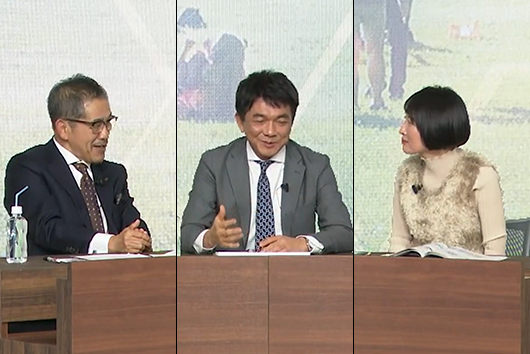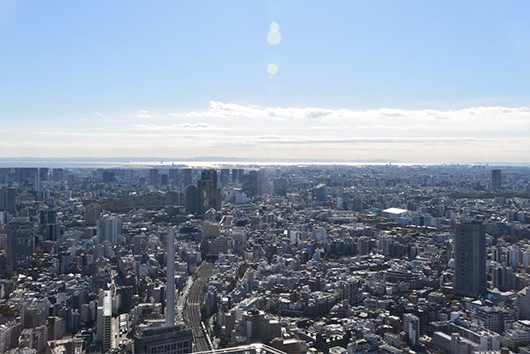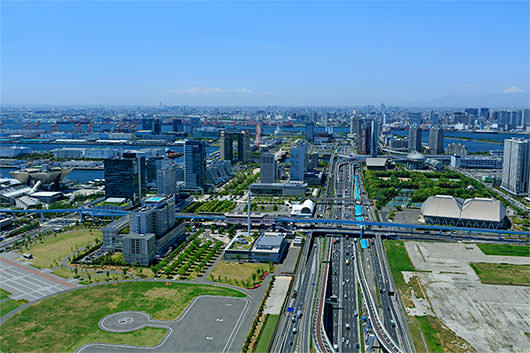

On February 18, 2021, Nikken Sekkei and PACIFIC CONSULTANTS co-hosted an event titled "Prospects for Cities and Regions in the Post-COVID Era." The two companies, which have worked together to solve urban challenges in "Transit-Oriented Development (TOD)" projects in central Tokyo, such as around Shibuya Station, presented research and recommendations under the theme of "Transformations Required for Cities and Regions, and the Future of Social Design." This initiative stemmed from an exchange of opinions held last summer by young and mid-career employees of both companies regarding the vision of cities in the post-COVID era, followed by activities conducted by a mixed working team. Here, we present an overview of the presentations given on eight themes, which comprehensively examined cities and regions from a multifaceted perspective, transcending specialized fields such as architecture, urban planning, and social infrastructure, and including energy and smart technologies.
INDEX
- [1] Rethinking the appeal of cities: Towards an autonomous, decentralized urban structure that leverages the unique characteristics of each city
- [2] Ways of working and living: Towards three hubs that support a "people-centered new normal"
- [3] Public spaces—Spaces that can be used from a "lifestyle perspective" and treated as "personal matters"
- [4] Transportation and Mobility – Towards a "mobility ecosystem" through diverse collaboration
- [5] Disaster prevention and risk management - Towards a resilient city that can coexist with disaster risks and create value
- [6] Environment and energy – Towards a city of choice that is eco-oriented
- [7] Smart digital – Towards an optimally sized "Hiking City" through urban management
[1] Rethinking the appeal of cities: Towards an autonomous, decentralized urban structure that leverages the unique characteristics of each city
A national survey on lifestyle changes during the COVID-19 pandemic revealed a decrease in activities in urban areas and an increase in activities around people's houses. Increased choice of locations has led to a greater demand for the use of nearby outdoor public spaces such as parks and plazas.
Furthermore, while online communication has increased in the workplace, a significant percentage of people still desire real-life connections, suggesting that the appeal of cities—where people, functions, and information converge—remains universal.
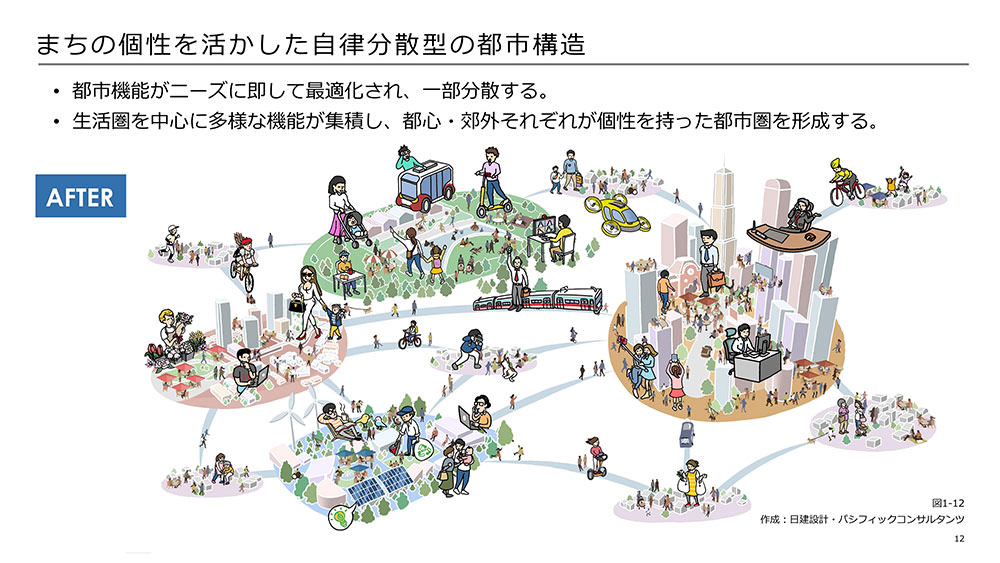
Therefore, I propose a "decentralized, autonomous urban structure that leverages the unique characteristics of each town." Instead of everything being concentrated in the city center, everything is decentralized autonomously to the surrounding areas, each becoming a town with its own distinct character.
To achieve this, it is necessary to leverage existing assets and infrastructure while managing new clusters that possess variability, flexibility, diversity, selectivity, and sustainability. This involves managing and optimizing resources, facilities, and services without becoming overcrowded. We believe that such "collections of living areas" will shape the cities of the future.
[2] Ways of working and living: Towards three hubs that support a "people-centered new normal"
With "a people-centered new normal" as our keyword, we considered our outlook for future ways of working and living.
First, using private statistical data, we compared the movement of people in the city center and suburbs during the COVID-19 pandemic. The results showed a 35% decrease in people around two stations in the city center (Marunouchi and Shinjuku), and a 12% decrease in people around two stations in the suburbs (Hashimoto and Tachikawa).
Furthermore, a survey on teleworking after the end of the COVID-19 pandemic revealed that 70% of respondents plan to expand or maintain teleworking and also want to utilize satellite offices.
Based on these studies, we predicted that work styles would become a hybrid of shared workspaces and remote work, with people using different locations depending on their lifestyle. From there, we categorized these into three types: "city center," "suburbs," and "the nearest location in between," and envisioned the following future scenario.
- City Center: Evolving into a more open space for creative communication. The focus will shift from solely on office functions to improving the living environment as well.
- Suburbs: Develop workspaces within own houses or in common areas.
- Nearest base: We will develop facilities between the city center and the suburbs that allow for social interaction that cannot be done at home.
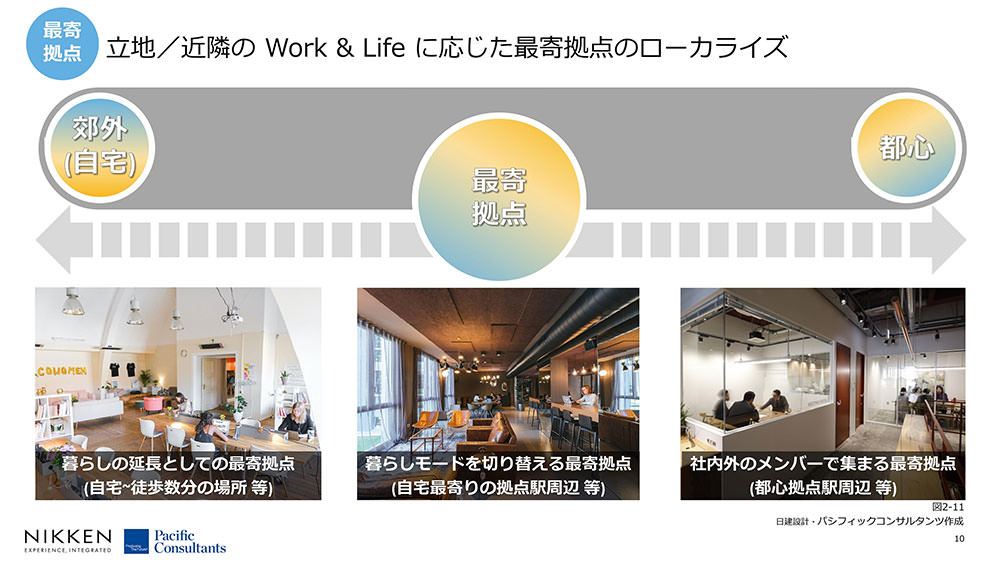
Furthermore, in order to move away from the urban structure of having two bases—an office in the city center and a home in the suburbs—and realize three bases that support a "people-centered new normal," we believe it is important to combine public spaces, mobility, energy, and other elements in a complex way.
[3] Public spaces—Spaces that can be used from a "lifestyle perspective" and treated as "personal matters"
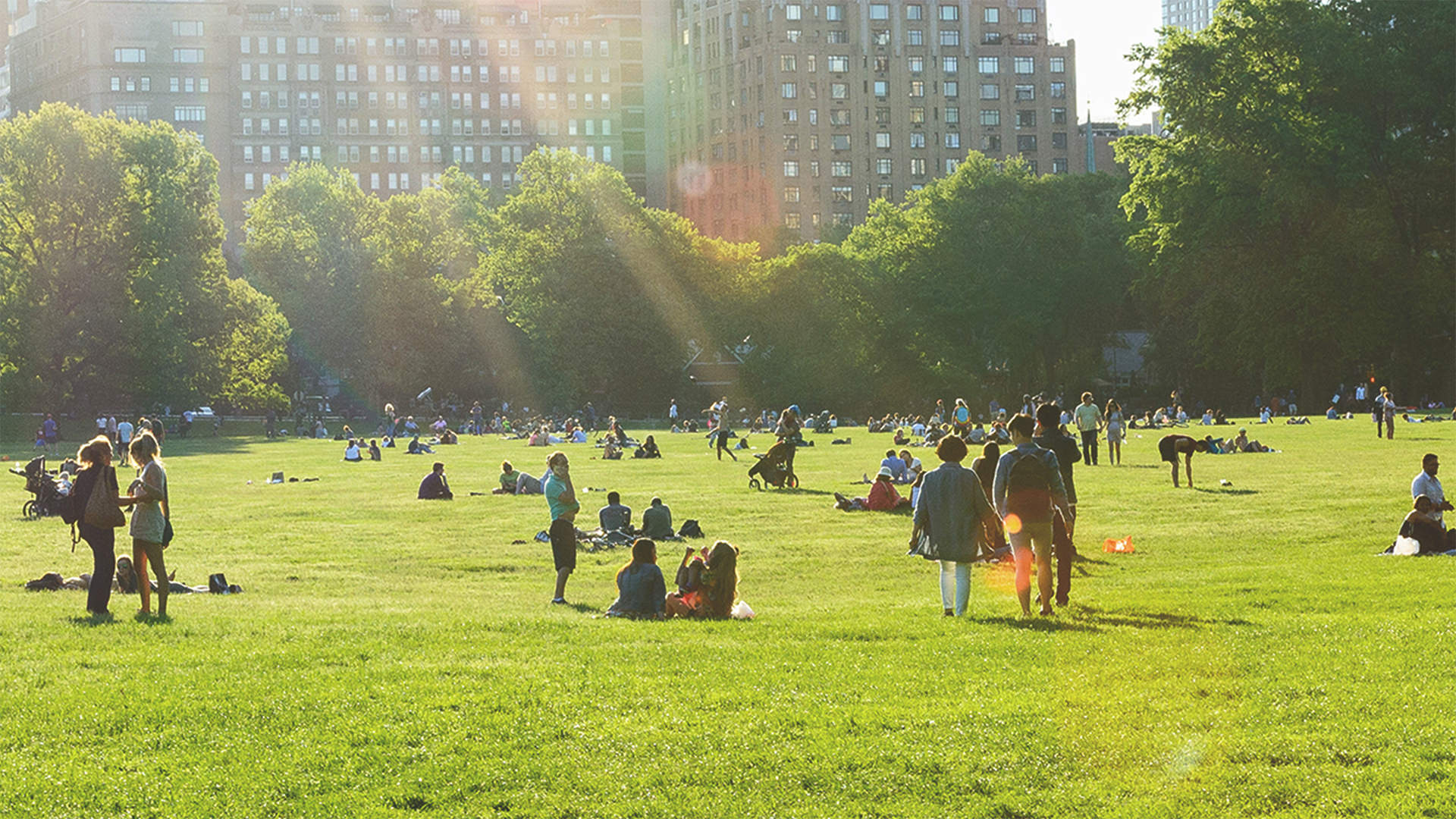
The COVID-19 pandemic has highlighted the increased need for relaxing outdoor spaces in urban areas. Therefore, we will explore the potential of public spaces to enhance quality of life in cities.
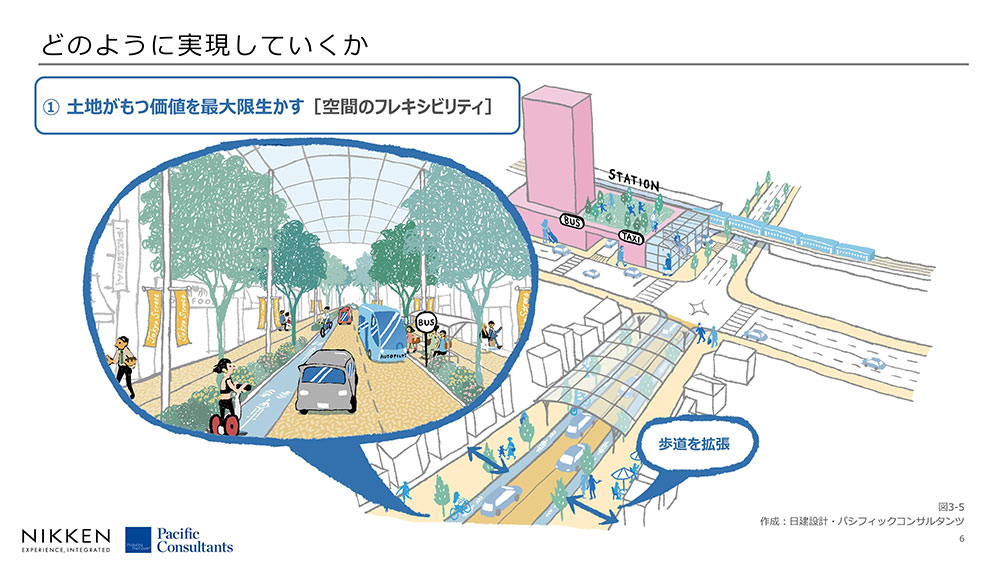
What would happen if we increased the flexibility of space, subjectivity, and time? — We depicted this using the space in front of the train station as an example.
1. Spatial flexibility: Maximizing the value of the land
By creating a multi-level station plaza to utilize the airspace above, and by opening up sidewalks on main streets through public-private partnerships, the diversity of space utilization will increase.
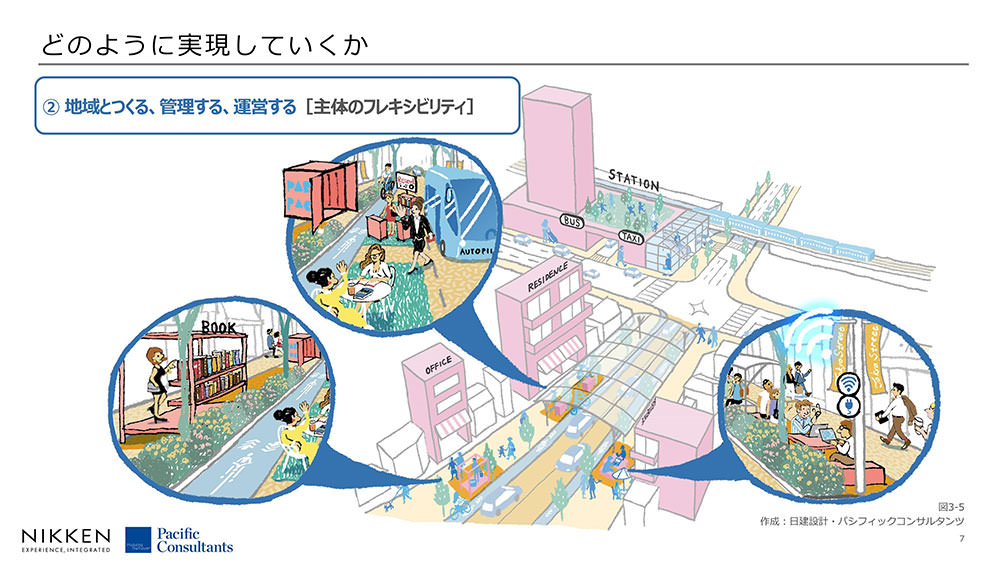
2. Flexibility of the entity: Creating, managing, and operating with the community
By enabling the use of street-level space for shops facing the main street in front of the station, and by also handling its operation and management, we can increase flexibility in usage and efficiency in maintenance.
3. Time flexibility: Use as much as you need, when you need it.
Furthermore, by utilizing the roads according to the time of day—primarily for mobility during rush hour and as a park on weekends—in other words, through time-sharing, a richer public space is created.
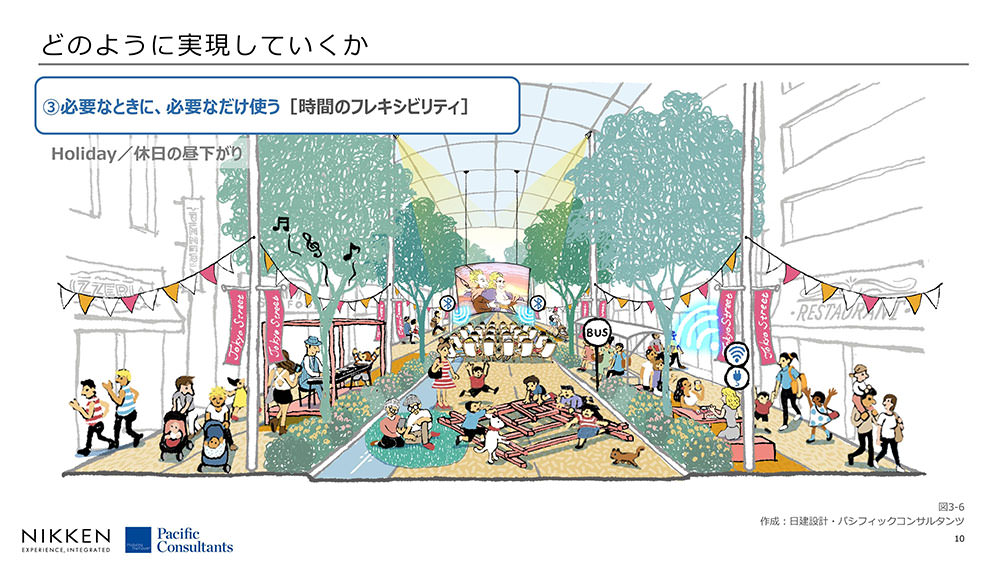
By removing the boundaries between public and private sectors, and between roads and parks, and other previously separated areas of management, we envisioned a future of public spaces where users can utilize them from a "lifestyle perspective" and treat them as "their own responsibility."
[4] Transportation and Mobility – Towards a "mobility ecosystem" through diverse collaboration
In Japan, a survey conducted in 2018, before the COVID-19 pandemic, showed that the movement of people had decreased by 10% compared to 10 years prior, while the movement of goods had increased 1.5 times. While IoT and digital transformation are bringing about changes in people's behavior and logistics, private surveys indicate that people's willingness to go out remains high, suggesting that movement will not disappear for the sake of physical and mental health.
In line with these societal trends, we predict that Mobility-as-a-Service (MaaS) will become more widespread in the future, and that services will be further enhanced through collaboration across different industries.
How will mobility evolve then?
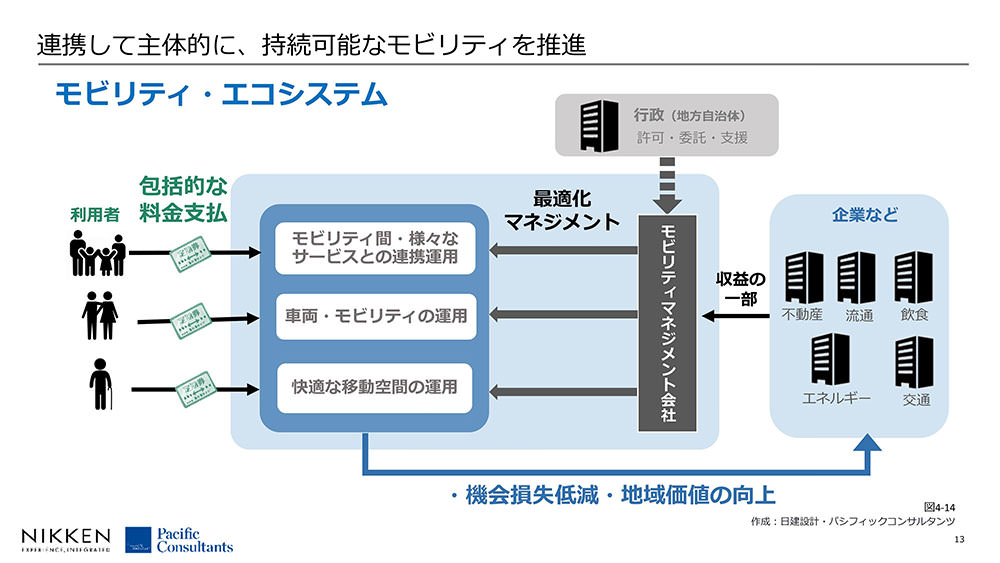
The emergence of subscription-based, evolving commuter passes opens up the possibility of providing a variety of services beyond just transportation, potentially creating new forms of mobility. This could lead to the appearance of multi-purpose vehicles serving not only transportation but also services like food and medical care, and simultaneously, the transportation landscape itself adapting flexibly to diverse needs.
In order to efficiently operate "evolving commuter passes" and "multi-use vehicles," we believe that creating a "mobility ecosystem" that collaborates with diverse stakeholders beyond the conventional framework of transportation services and optimally manages them will contribute to the evolution of mobility.
[5] Disaster prevention and risk management - Towards a resilient city that can coexist with disaster risks and create value
What direction should Japanese cities, which face significant disaster risks, take?
Major cities in Japan are located in areas with a high risk of natural disasters. Furthermore, research by the World Economic Forum shows that risks are complex, involving not only environmental factors such as the intensification of disasters due to climate change, but also social factors such as infectious diseases.
Therefore, I thought that by acknowledging the various risks involved, and by learning to mitigate and coexist with disasters, we could become a resilient city capable of creating value.
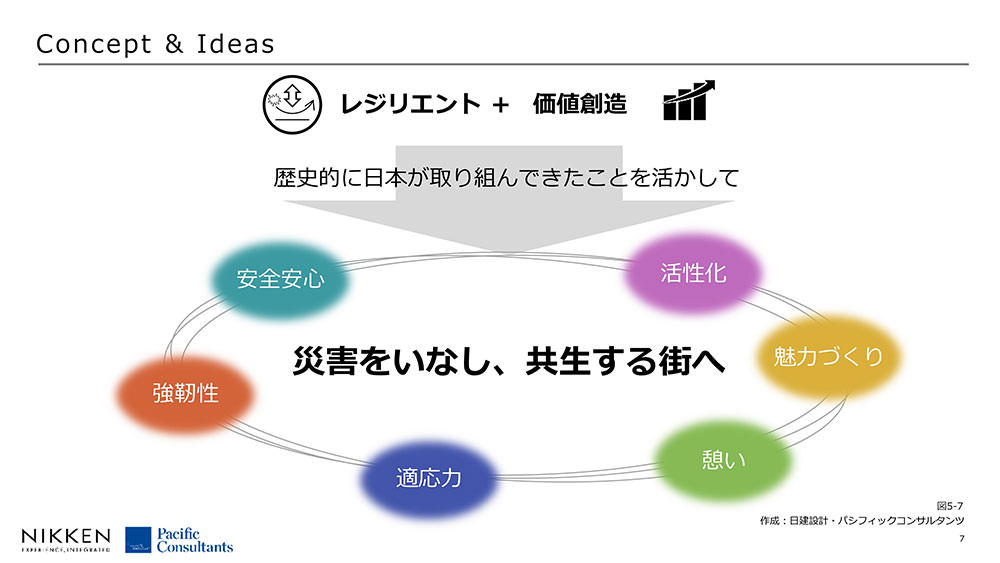
Specifically, we created concepts for four different scales: city, neighborhood, hub/facility, and local community.
- Improving urban resilience
This proposal proposes new methods utilizing big data from multiple perspectives, including optimizing location and infrastructure development with disaster prevention in mind, and providing disaster information and evacuation guidance using apps. - Smart Infrastructure Management
By centrally managing urban data, it can be effectively utilized for appropriate predictive maintenance and management of infrastructure and facilities, creating safe and secure neighborhoods. - Multi-use of space
This proposal proposes a space that can be adapted to different situations, such as a bustling area during normal times being converted into an evacuation center or medical facility during emergencies. - Improving disaster preparedness in local communities
Support for community building, including workshops to raise disaster preparedness awareness during normal times and the creation of diverse industries.
Furthermore, using "Build Back Better" as a keyword, based on recent disasters, we considered the possibility of creating a role model for Japan's disaster prevention and recovery expertise and providing that technology to other countries.
[6] Environment and energy – Towards a city of choice that is eco-oriented
The changes in lifestyle brought about by the coronavirus can be seen as an opportunity to optimize urban energy use and promote green recovery.
The increase in working from home due to the coronavirus pandemic has changed home energy consumption. In April, immediately after the declaration of a state of emergency, older homes had higher energy consumption, but during the summer months when air conditioning is needed, newer, more environmentally friendly homes actually consumed more energy.
On the other hand, it appears that newly built homes currently account for only 2% of the total floor area of existing housing stock. To improve the overall environmental performance of cities, we believe it is necessary to focus not only on buildings but also on the renewal and transformation of urban infrastructure.
Therefore, we consider optimizing energy use to suit new lifestyles from both the demand-side (Human Activity) and supply-side (Urban Planning) perspectives.
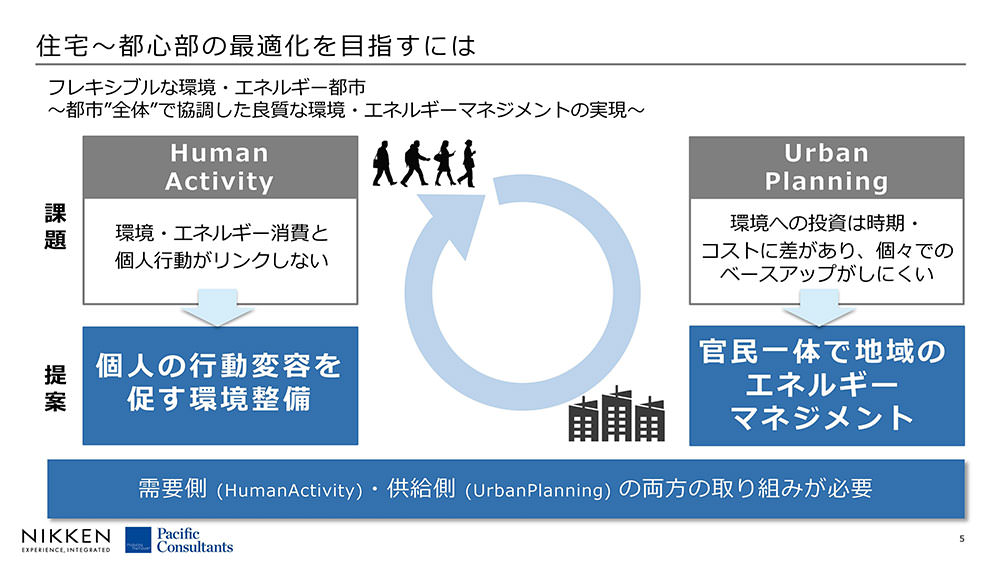
Here are two specific proposals for optimizing energy use:
1. Creating an environment that encourages individual behavioral change
Social initiatives such as providing incentives to encourage the development of environmentally friendly cities and buildings, as well as technological advancements that adapt to human behavior rather than uniform environmental adjustments, are necessary.
2. Public-private partnership for regional energy management
There is a need to optimize the functions of storage (batteries and thermal storage) and distribution (networks) by utilizing the know-how and technology of multiple businesses, as well as the public infrastructure and space of local governments, such as through the exchange of electricity between regions.
In Japan, efforts toward carbon neutrality by 2050 are accelerating, and globally, there is a growing demand for cities with high environmental performance. Amidst increasing inter-city competition, we envisioned creating an "eco-oriented city of choice" through collaborative efforts on both the demand and supply sides.
[7] Smart digital – Towards an optimally sized "Hiking City" through urban management
In today's world, where human movement is being digitized and visualized in greater detail using mobile phone location data, this proposal aims to maximize the effective use of such information technology in areas ranging from energy and space utilization to infrastructure maintenance and management.
The urban development concept we are promoting here is "Hiking City." This likens traditional cities to "climbing," where you follow a limited route to a localized destination, and aims to create a "suitable-density city" that offers users a high degree of choice in how they utilize space, in contrast to that.
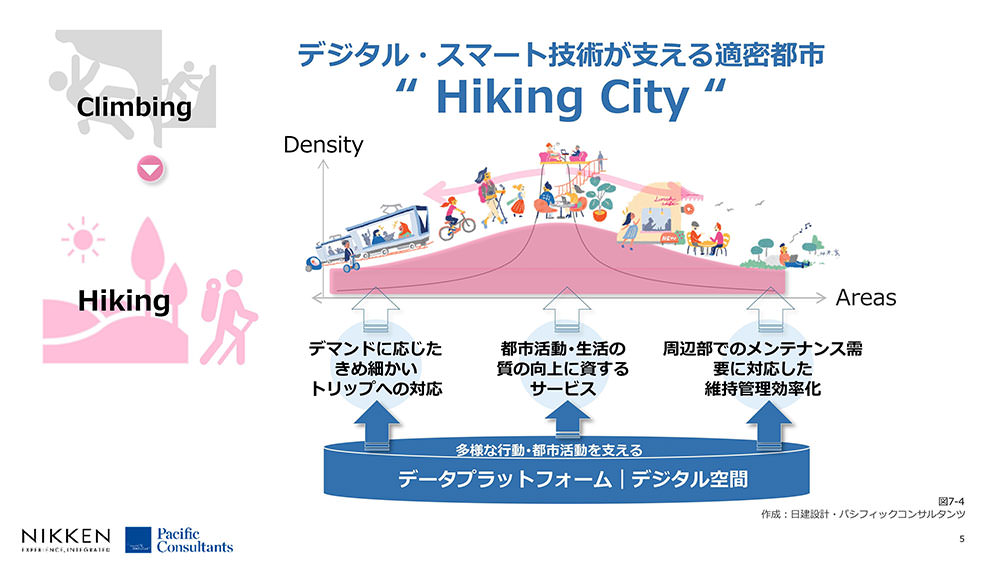
We aim to create urban services that make life more comfortable by utilizing big data obtained from cities. Specifically, we envision a city that incorporates flexible use of public spaces, time-sharing and multi-use of road spaces, and information provision that enhances the enjoyment of travel and promotes connectivity.
In the future, we plan to utilize 3D city models to facilitate data sharing and integration, and optimize urban services as a whole, thereby promoting the creation of "optimally dense cities." We also envisioned incorporating underground infrastructure information into the 3D city models to enable comprehensive urban management.
◆ Pacific Consultants YouTube Channel (Videos)
Part 1: "Transformations Required in Cities and Regions, and the Future of Social Design" - Research and Recommendations by Working Members from Both Companies -
Part 2: Panel Discussion "Prospects for Cities and Regions in the Post-COVID Era"
[Working Members]
- [1] Rethinking the Appeal of Cities: Masato ITO, Yukito KARASAWA (Nikken Sekkei) / Masatoshi MATSUMOTO (PACIFIC CONSULTANTS)
- [2] Work Styles and Living Styles: Takahiro HIRASHITA, Masato WADA (Nikken Sekkei) / Ryo IWATA (PACIFIC CONSULTANTS)
- [3] Public Spaces: Takeshi NIITANI, Jun-Yi Huang (Nikken Sekkei) / Ryoko SASAKI, Yukiyasu MITSUI (PACIFIC CONSULTANTS)
- [4] Transportation and Mobility: Kazuki SUZUKI, Chika Kim (Nikken Sekkei) / Takeshi WATANABE, Aya TAZURU (PACIFIC CONSULTANTS)
- [5] Disaster Prevention and Risk Management: Yushi YOSHIDA, Yuka BABA (Nikken Sekkei) / Kosuke NAKAGAWA, Lucas Albes (PACIFIC CONSULTANTS)
- [6] Environment and Energy: Ryo TSUTSUMI, Kazuki YAMADA (Nikken Sekkei) / Mika HASEGAWA, Gen IKEMOTO (PACIFIC CONSULTANTS)
- [7] Smart Digital: Norio YOSHIMOTO, Shinji Kang (Nikken Sekkei) / Kenichi SAKAI, Takeshi KONO (PACIFIC CONSULTANTS)
- [8] New Leaders of the City: Motohiko YOKOSE (Nikken Sekkei) / Takahiro NAKAGAWA, Kyohei KUNO (PACIFIC CONSULTANTS) *Please watch the video