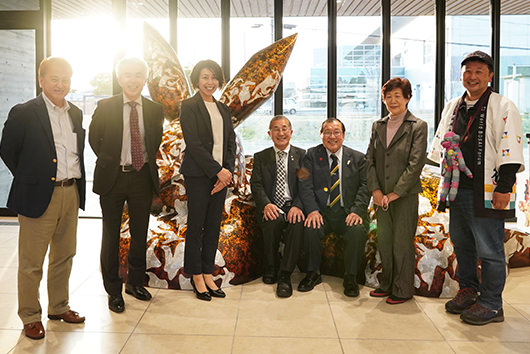

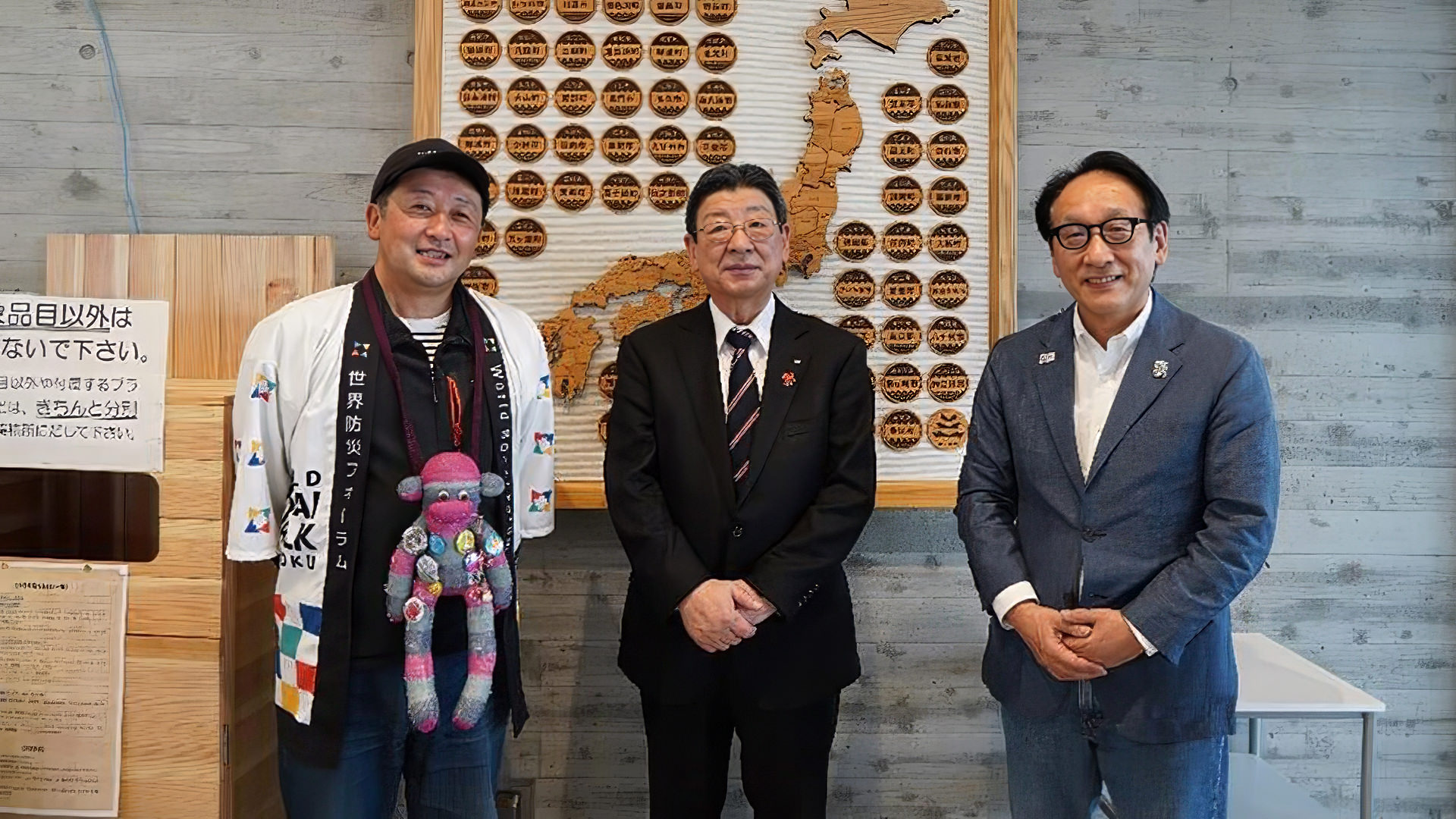
Sunday, April 10th, was the second day of the Minamisanriku Town event. We will report on the first part, "Looking Back on 10 Years of Reconstruction," which included an interview Mr. Jin SATO, the mayor of Minamisanriku Town. The location was "Machidoma," the first-floor lobby of the new Minamisanriku Town Hall, which was completed in September 2017, six and a half years after the earthquake. More than 10 years have passed since Great East Japan Earthquake, and an interview was conducted with Mr. Jin SATO, mayor of Minamisanriku Town, who has been working on disaster recovery. This time, we were joined with Fumihiko IMAMURA, Director of the International Research Institute of Disaster Science, Tohoku University which was established in April 2012 after the Great East Japan Earthquake, and who has been involved in disaster prevention research and local disaster prevention activities in Tohoku region since before the earthquake.
INDEX
- Things I remember from the time of the earthquake
- Looking back on our past efforts, and looking ahead
- Part 1: "Looking Back on 10 Years Since Reconstruction" - An Interview of Mr. Jin SATO, mayor of Minamisanriku Town
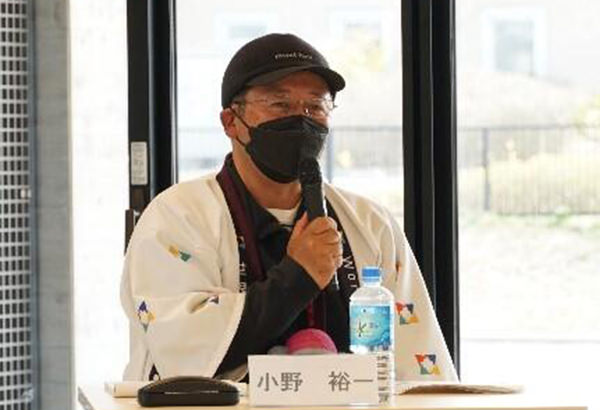
In the hard situation just after the disaster, what were Mayor SATO and the townspeople thinking and how did they respond at each stage? And what needs to be done next? We asked the Director Fumihiko IMAMURA together. The interviewer was Professor Yuichi ONO from International Research Institute of Disaster Science, Tohoku University who is participating in WORLD BOSAI WALK TOHOKU+10 as the representative director of World BOSAI Forum.
Things I remember from the time of the earthquake
Mayor SATO: A few days after the earthquake, Professor IMAMURA visited the town's general gymnasium, where the disaster response headquarters was located. He said, "I have been working as an expert on earthquakes and Tsunamis for a long time, but I am sorry that I could not predict the scale of this Tsunami and the damage." This made me reflect once again on the professor's character and realize that this earthquake was on a scale that even experts found difficult to anticipate.
The reconstruction plan was created with a 10-year target in mind, but now I realize that leveling mountains and raising low-lying land will take a considerably longer time.
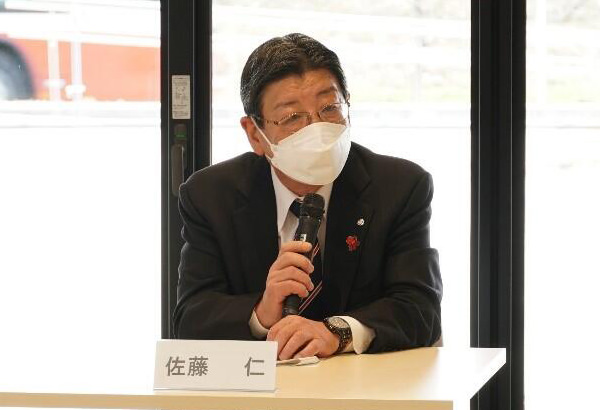
Director IMAMURA: Minamisanriku has repeatedly experienced Tsunami damage from the Sanriku earthquakes of the Meiji and Showa eras, and the Chilean earthquake. We have been working on disaster prevention urban planning that can accommodate not only local residents but also visitors and anglers. We even held a disaster prevention symposium a year before the earthquake, so it was a region with a high level of disaster awareness and active participation. When I saw the extent of the damage, I was stunned and speechless. Even as an expert, I felt the magnitude of the disaster was beyond what we had anticipated, and I keenly felt the difficulty of preventing such a disaster. We had conducted training, but I apologized that it was not sufficient for the Great East Japan Earthquake. Eleven years have passed since the earthquake, but our goal is to never let such disaster happens again.
Mayor SATO: The day after the earthquake, 10,000 people had taken refuge in the shelters, and a major problem was how to provide 30,000 meals, three meals for each person. I remembered a point I had heard in a lecture by someone who had experienced the Chuetsu earthquake: "It's important to have a good relationship with the media." Minamisanriku is a small town sandwiched between Kesennuma to the north and Ishinomaki to the south, so we decided to actively disseminate information in order to avoid being hidden and buried by the larger cities. On March 12th, the day after the earthquake, I set up a press conference with four staff members who were nearby. After that, we held press conferences every day at 3 p.m. Thanks to this, relief supplies and other goods started to arrive from the surrounding areas, and I realized how powerful the media is. The town hall was also swept away, and we were left with only the clothes on our backs, with no food nor money whatsoever. To obtain supplies, I sent staff members inland to purchase them, and at that time, I had them carry employee identification cards with "This person is an employee of Minamisanriku Town Hall" hastily scribbled on rough paper. Some shops even sold to us on credit. The first thing the staff member bought at that time was baby milk. I remember that I praised the staff member highly for prioritizing the support of infants and toddlers.
Director IMAMURA: Information dissemination is important not only during disasters but also during normal times. When the head of an organization clearly communicates information, the detailed situation can be conveyed. In this earthquake, individual volunteers gathered, but there was a lot of support from companies and organizations. I think a major factor was that the mayor communicated the situation in the town in real time and in an easy-to-understand way.
Looking back on our past efforts, and looking ahead
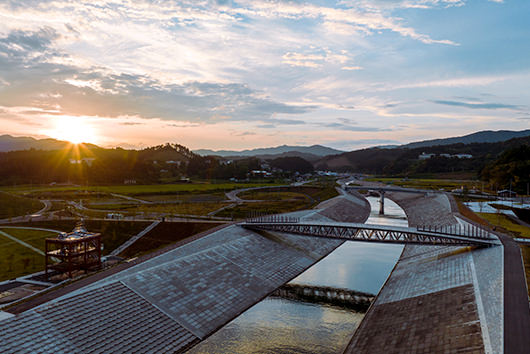
Mayor SATO: The relocation to higher ground, decided the month after the earthquake, is the top priority of the reconstruction plan the town has been pursuing. To that end, we held more than 23 meetings with residents in one week to explain the plan. Having experienced four times of Tsunami disasters in the past, and each time losing valuable property and lives, there was not a single person who opposed the relocation to higher ground. The relocation project has completed, and everyone is already living on higher ground. Minamisanriku Town is the only town in the prefecture that does not issue evacuation orders even when a Tsunami warning is issued. Thanks to the past experiences, we have achieved a daily life where we do not have to pack our belongings and evacuate to higher ground every time a Tsunami warning is issued.
The most important thing to do now is to complete the reconstruction projects, which can be achieved within this fiscal year. The memorial hall, currently under construction, is scheduled to open in October. This will be a "place to express gratitude" to those who provided support after the disaster. It is also positioned as a place to think about disaster prevention. We interviewed more than 90 people who experienced the earthquake and compiled their individual experiences into a single story. A unique feature of the video is that it asks "If it was you, what would you do?" at each scene, making it a learning program that encourages viewers to think about disaster prevention actions for themselves. Natural disasters can happen anywhere, not just in Minamisanriku. It is important to think about disaster prevention for oneself, and in the future, it will be important for local governments and residents to discuss what the post-disaster situation will look like as part of pre-disaster recovery.
Director IMAMURA: From now on, transmission of knowledge and disaster prevention education will be important. It is important to record the experiences of that time and create "places to see and learn." However, memories inevitably fade away and do not lead to action. This is unavoidable in the course of daily life. By conveying the information more carefully, it will lead to "surprise" and "awareness," which will eventually lead to action. I believe that transmission of knowledge that values this process is necessary. Based on the information conveyed from the experience of Great East Japan Earthquake, Kochi Prefecture has formulated a pre-disaster recovery urban development plan.
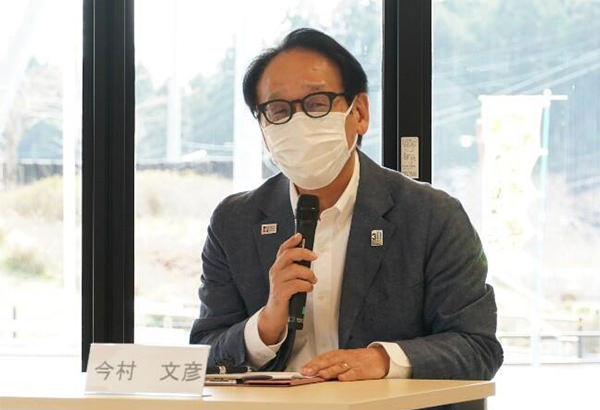
Mayor SATO:In order to recover a town, we need the combined strength of not only the government but also the private sector. Despite the severe damage, the business owners held a recovery market in the month just after the earthquake. This was a testament to the efforts of the private sectors. The recovery market brought together people who had evacuated and left town, and it became a place for them to check on each other's safety. At the end of May, it will finally reach its 100th time of anniversary. In addition, the town is changing by various challenges. To promote sustainable forestry, the foresters have obtained international certification. The fishing industry suffered significant damage when oyster farming rafts were washed away by the Tsunami, but environmentally friendly aquaculture has also received international certification. We have reapplied for the Ramsar Convention for Shizugawa Bay, which had been postponed due to 3.11, and has now been registered. In the future, we would like to share this kind of sustainable town development with the whole country and the world.
Finally, I believe it is the duty of the town's administration and residents to continue expressing our gratitude for the support we received after the earthquake.
Part 1: "Looking Back on 10 Years Since Reconstruction" - An Interview of Mr. Jin SATO, mayor of Minamisanriku Town
Immediately after the earthquake, a disaster response headquarters was set up in the gymnasium, and the desperate situation at the time, where a small number of staff members worked together to restore the town, was conveyed. It also conveyed the strong desire of the town and its residents to "do something to save the town." Furthermore, Professor IMAMURA, who has been involved in disaster prevention research and activities in Tohoku for a long time, seemed surprised by the scale of the tsunami damage. I felt his strong determination as an expert to "never let such disaster happens again" and "must widely share this experience."
The press conference held by the town mayor after the earthquake provided "careful information dissemination," which helped the lives of the victims and led to subsequent support activities by companies and organizations—a valuable lesson for the future. Now, Minamisanriku, which has experienced Tsunami damage four times in the past, has completed its relocation to higher ground, driven by a strong desire to never again experience the same damage. While this has drastically changed the familiar appearance of the town, it has brought a sense of security to daily life that was previously unavailable. Furthermore, the construction of a memorial hall incorporating "passing on" the experiences of the disaster and "disaster prevention education" that encourages residents to think for themselves, along with sustainable town development initiatives by those involved in commerce, forestry, and fisheries, are bringing vitality back to the town and its people.
Finally, the gratitude of Mayor SATO and the townspeople, which we have been shared through various forms of support for reconstruction, both in the past and in the future, will "never be forgotten," and will continue to be the starting point for ongoing reconstruction efforts. Once again, I was deeply moved by the strong determination of the people in the disaster-stricken area toward reconstruction, and it made me want to continue to care about them and visit the town again.
https://www.youtube.com/watch?v=SA5gCcppXY4