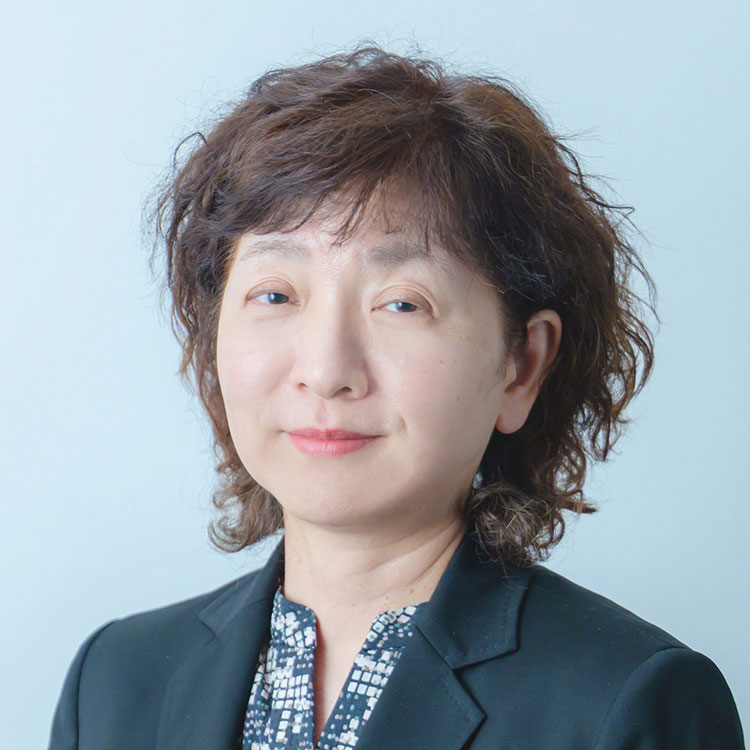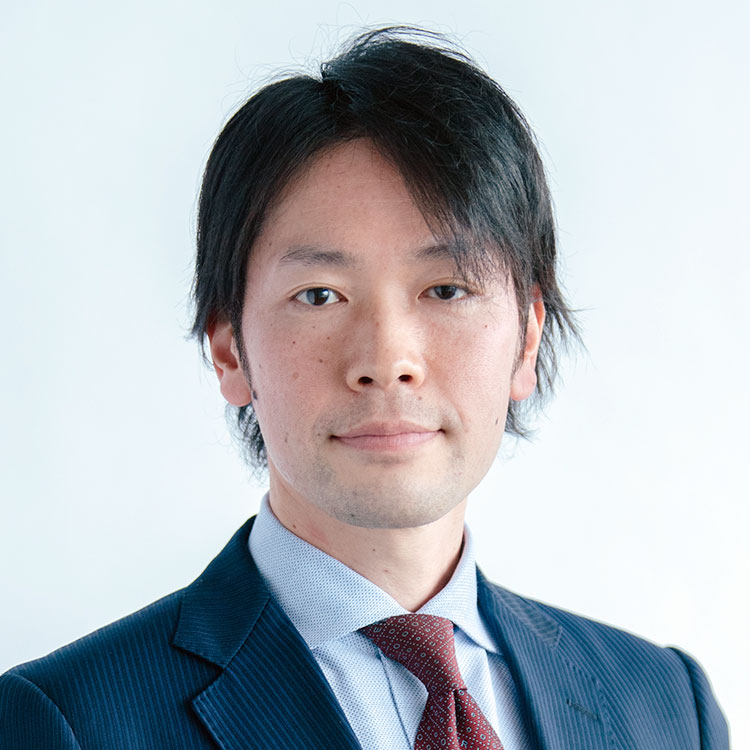


In October 2025, coinciding with the start of the 75th fiscal year, PACIFIC CONSULTANTS established a new Solution Business Division. This new organization will work alongside private companies aiming to solve increasingly complex and diverse social issues and provide new value, to design and consider commercialization of customer-centric solutions and also support its implementation as a business. What exactly is the solution business that our company provides, and what is our goal for the future? We spoke with Director General - Kumiko KAJII and General Manager of Business Design Dept.- Daisaku TANAKA to find out.
INDEX
- Various social challenges faced by private companies
- The immediate mission of the Solution Business Division
- Starting to expand collaboration with private companies
- Leveraging PACIFIC CONSULTANTS' challenging corporate culture
Various social challenges faced by private companies
—Could you tell us about the solutio business that our company provides?
KAJII: Currently, Japanese society faces a variety of challenges in many areas, including cities and infrastructure that support daily life, regional industries, disaster prevention, environment and energy, and welfare, against the backdrop of a rapidly aging population and declining birthrate, as well as an increasing frequency of natural disasters. Moreover, these challenges are becoming more complex and diverse. Naturally, these cannot be solved by government policies alone, and private companies are also being asked what contributions they can make to solve these problems. Furthermore, private companies themselves are currently unable to gain the support of various stakeholders, including investors, unless they adopt a so-called ESG management perspective. In this context, our company has recently received requests from developers and railway companies, for example, to work together to consider strategies on how to envision the smartification of cities, and from energy companies, to consult on how to proceed with the implementation of cutting-edge decarbonization technologies.
Up until now, our services have primarily focused on supporting government agencies such as national, prefectural, and local authorities. However, going forward, we intend to more clearly position the provision of solutions for private companies as a business and put even more effort into it.
TANAKA: In Medium-Term Management Plan 2028, PACIFIC CONSULTANTS has made "Contributing to a sustainable society" the cornerstone of its basic policy, and aims to actively engage in the private sector and provide a wider range of solutions by focusing on solving customer-centric problems. I believe that this Solution Business Division was established precisely to carry out this. We conduct our business activities under the vision of "Producing the Future." The "Future" we should consider is not limited to the public market. Furthermore, in order to "Produce," we believe that it is necessary not only to ensure the required quality, but also to actively participate in the formulation of higher-level policies and strategies. In addition, our management philosophy is to "Continue to provide new value to society through advanced integrated solution services." This means not only staying within the engineering domain of survey, planning, and design, but also combining the group's resources to maximize the impact on society and proceed with our work with the aim of providing new value.
—So, you meant going beyond the traditional realm of engineering?
TANAKA: In an interview, the President OMOTO said, "We delve deeply into challenges from a different perspective than traditional construction consultants," and "While communicating with persons in charge from private companies, we propose business models based on the realization that 'this too can be a job.'" I believe our major mission now is to provide a wide range of solutions that transcend industry boundaries in order to meet the complex and diverse needs of private companies. This is not simply consulting. We envision it as supporting businesses at each phase, from vision to implementation, including "Story design" in the form of vision and strategy formulation, "Business design" in the form of business feasibility studies based on that, and "Process design" as supporting its implementation. Furthermore, we believe that it is also about promoting this by combining it with the value that Our Group Companies possess (energy business, privatization business, etc.) as needed.
KAJII: Our company has received a lot of work from various private companies and has also experienced some iconic big projects. Building on that experience, we want to deepen our understanding of the challenges our customers face more than ever before, grasp their more fundamental needs, and proactively propose, "So, how about considering this approach?" We want to pursue a style that is thoroughly attentive to our customers. Furthermore, our strength lies in our comprehensive capabilities, which are backed by the technological capabilities across multiple fields, including those of our group companies. At our division, we want to leverage and maximize the potential of the entire group and design new businesses in the private market.
The immediate mission of the Solution Business Division
—What kind of projects will you be working on from now on?
KAJII: We've been having extensive discussions within the company, and we've received a lot of opinions and ideas about what we could do in the private market, which gives us a great sense of potential. In order to maximize the group's expansion into the private market, we are considering four specific activities.
One of our goals is to leverage our experience in the private sector while striving to provide solutions that have a greater social impact and can serve as models for society. We aim to create solutions that solve our customers' problems, which in turn contribute to solving social problems, and whose impact is tangible both quantitatively and qualitatively.
Secondly, we will lead the development of a flexible framework and structure through group collaboration and alliances to provide optimal solutions. Our group comprises companies with unique strengths in a wide range of fields, including energy, information technology, environment, public-private partnerships, and funds. We will fully utilize group resources while being mindful of matching customer needs. In addition, we will actively promote co-creation and alliances with partner companies.
The third point is to develop systems and personnel that emphasize relationships with private sector customers so that we can thoroughly meet customer needs. We hope to create relationships where we can carefully understand our customers' problems, earn their trust over the long term, and continue to provide value.
Finally, as the fourth point, we envision the Solutions Business Division taking on a platform function for private market development within the group, creating a positive cycle where the aggregation and sharing of various information from the private sector leads to further improvements in services for private customers.
TANAKA: I myself have had the opportunity to engage in diverse forms of communication through outsourcing and joint ventures with private companies, and what I've come to realize is that trust between people is extremely important. It's necessary to build relationships with a different mindset than you would in the public sector, so I think relationship management is very important. I also think that a change in our own mindset is necessary.
Starting to expand collaboration with private companies
—Including those relationships that existed before establishment of the division, your interactions with private companies have actually increased, haven't they?
TANAKA: Earlier, I mentioned that we provide solutions in three phases: "Vision and Strategy Formulation," "Commercialization under Consideration," and "Implementation Support." The following table illustrates this in concrete terms. We have already achieved several successes in each phase.
| Vision and Strategy Formulation | Long-term vision and medium-term management plan | Amidst the rapidly changing social environment, we formulate a medium-term vision for the future and a long-term vision that looks beyond that. |
| Area and base development vision and strategy | This includes formulating strategies and action plans that contribute to improving area value, such as decarbonization, in urban development projects undertaken by private railway companies and developers, as well as formulating visions for next-generation energy hub development projects undertaken by power companies and other organizations. | |
| Private sectors' strategies for utilizing public spaces | Formulating strategies for utilizing public spaces such as roads, rivers, parks, and ports. This includes organizing promotion schemes and related subsidy programs, and providing support for specific applications. | |
| Commercialization under Consideration | Area development scheme consideration | To further enhance the value of the area, we are considering a development scheme that integrates the redevelopment of the surrounding area with the development of the base. |
| Considering the commercialization of next-generation infrastructure development projects. | We are exploring the possibility of developing businesses for next-generation infrastructure such as power storage plants and data centers. | |
| Public-private partnership project under consideration | Support for the commercialization of public-private partnership projects related to the development of public facilities such as parks. This includes forming consortia, preparing proposals, and implementing project management to facilitate subsequent project implementation. | |
| Considering the optimization of disaster resilience measures | We support maximizing project effectiveness, such as reducing project costs through comparative studies of disaster prevention methods, costs, and durations within corporate business premises. | |
| Implementation Support | Base Development Project Management | From formulating basic plans for base development to project management support for implementation. This includes assistance with selecting designers and contractors, as well as conducting specific coordination. |
| Social experiment planning and management | This involves conducting social experiments to verify the effectiveness of actions outlined in strategies and other objectives. It encompasses everything from specific planning to procurement and on-site operational management. |
One of our social experiment planning and management activities involves establishment and operation of the Park Line Promotion Council. This council was launched in December 2020 as a subcommittee of the "Research Group on the Future of Public Infrastructure," which was established primarily by PACIFIC CONSULTANTS and Taisei Corporation (and will become a general incorporated association in 2024), and is conducting social demonstrations in various regions.
On May 23rd and 24th, 2025, a social experiment titled "Yokohama Nishiguchi OPEN PARK #01 Ekimae," concerning the transformation of the Yokohama Station Central West Exit Plaza into a park, was conducted at the west exit of Yokohama Station. "Yokohama Nishiguchi OPEN PARK" was organized by the Yokohama West Exit Area Management Association, with Pacific Consultants participating as a planning and operational supporter, exploring the possibilities of a new station plaza.
KAJII: We are also participating in the energy business in collaboration with Pacific Power, a group company of ours. In addition to its core business of Power Producers and Suppliers (PPS) generation for local governments, Pacific Power is expanding its business through solar power PPA projects, VPP projects, and proprietary technology development. Its concept of returning profits to the community and promoting regional development has been well-received, and it is increasing its sales. Decarbonization is one of the important issues for many private companies, and we are exploring ways to provide solutions by combining it with these regionally-oriented energy businesses.
TANAKA: Going forward, we will be required to address social issues in a more multifaceted way than ever before. Without being confined to the framework of a construction consultant, we want to expand our scope in line with changes in the business environment, collaborate with various private companies, and provide new value for the future.
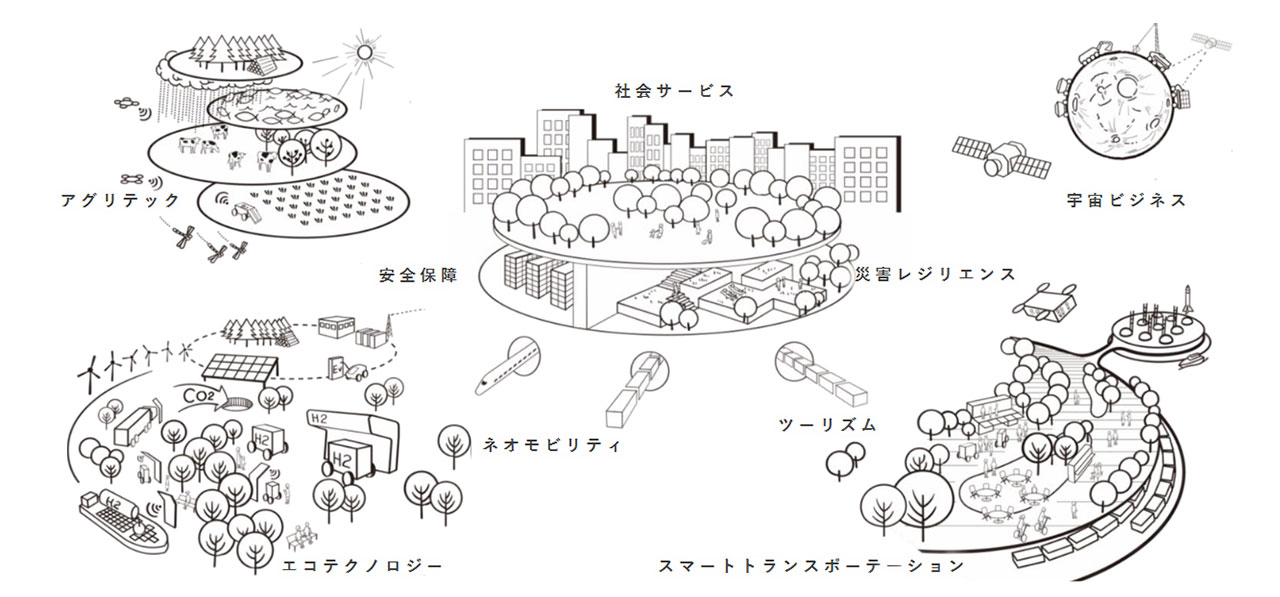
Leveraging PACIFIC CONSULTANTS' challenging corporate culture
—Please tell us about your aspirations to lead this new business.
TANAKA: About five years ago, I had more opportunities to interact with private companies through my involvement in creating new projects in Project Management Dept., and I became aware of the current situation where many companies are being forced to address ESG issues. In urban development, it's no longer enough to just build public facilities, commercial facilities, or office buildings; the question is now whether they are sustainable for the region from the perspectives of community building, creating vibrancy, and decarbonization, and we have actually received consultations on these kinds of concerns. Investors are also paying attention to this point. As the line between private and public becomes increasingly blurred, the Solution Business Division is trying to challenge itself with businesses that will be born precisely at that boundary. By creating many successful models, we want to literally "Producing The Future."
KAJII: I think PACIFIC CONSULTANTS has traditionally had a spirit of taking on unprecedented initiatives and extremely difficult projects with enthusiasm, from its founding to the present day. In fact, since the establishment of this division, what I've felt from talking to people within the company is that there are many people who say, "That sounds interesting." The Solution Business Division is a condensed version of PACIFIC CONSULTANTS' pioneering spirit, and its job is to conceive and give shape to those "Interesting" ideas. We will continue to challenge ourselves toward new possibilities, and I want this division to be a driving force that inspires ideas from all departments within the company to say, "Let's try this too."
—I'm looking forward to seeing what happens next. Thank you very much.